Design Studio Review
Ramotion Review 2026: Strong Design Systems for Startups
Searching for a Ramotion review? trying to figure out whether Ramotion is the right studio for your startup.
Limited Monthly Offer
Unlimited Requests
Design + Development
Animations Included
Fixed Monthly Price
If you are searching for a Ramotion review, you are probably trying to figure out whether Ramotion is the right studio for your startup, SaaS brand, or tech company.
You may already know they work on brand identity, UI/UX, marketing websites, app design, and product visuals.
But the real question is:
“Can Ramotion help my company build a design system that feels polished, consistent, and ready to scale?”
That is what I want to answer in this article.
Ramotion sits in an interesting space because they are not only a branding studio, and they are not only a product design studio either. Their work connects both sides. They help companies look better from the outside, but they also seem focused on how the product experience feels once people actually start using it.
For SaaS and tech companies, that matters a lot.
Your brand cannot feel premium on the homepage and then fall apart inside the app. Your product UI, landing pages, icons, dashboards, sales pages, and visual identity all need to feel like they belong to the same company.
That is where a studio like Ramotion becomes relevant.
Hi I am Subarno, a designer and no-code developer working with founders, startups, and agencies on websites, landing pages, and product interfaces. I design in Figma and build with Framer, Webflow, and modern no-code tools. Because of that, I tend to look at studios from both angles: the visual quality and the practical product value.
So when I look at Ramotion, I am not only looking at whether the visuals are clean. I am looking at whether their work feels useful for a real startup or tech company that needs better trust, stronger positioning, clearer UI, and a more scalable design system.
Ramotion has a strong reputation for SaaS branding and product visuals.
But is it the right studio for your stage, budget, and design needs?
Let’s break it down clearly.
Quick Verdict: Should You Hire Ramotion?
Ramotion is a strong option if you want a design partner that can connect brand identity, product UI, marketing websites, and SaaS visuals into one consistent system.
I would mostly recommend Ramotion for funded startups, SaaS companies, B2B tech companies, AI products, fintech companies, cybersecurity companies, healthcare tech brands, and product teams that need their brand and product to feel connected. Ramotion’s own site says it works with digital products and brands across different lifecycle stages, from startups to established businesses with tech leverage.
The biggest reason to hire Ramotion is that the studio appears very strong at the intersection of brand and product. Their website literally describes their work as sitting “at the intersection of product and brand,” and says their services allow them to design, develop, implement, maintain, and extend a consistent experience across touchpoints.
But Ramotion is probably not the best fit if you only need a cheap landing page, a simple logo, or a very basic Webflow build.
Public pricing signals show that Ramotion is a premium studio. Clutch lists Ramotion with a $50,000+ minimum project size, a $150–$199 hourly rate, 10–49 employees, and a 4.9 rating from 29 reviews. Clutch also says reviewed project costs range from $12,000 to over $150,000, with the most common project size being $50,000–$199,999 based on 24 reviews.
So, my quick verdict is this:
Hire Ramotion if you want serious SaaS branding, product visuals, UI/UX, marketing site design, or a design system that can scale with your tech company. Do not hire Ramotion if you only need a cheap, simple website or a small one-off design task.
What Is Ramotion?
Ramotion is a digital product and brand design agency headquartered in San Francisco. Its official website says the agency creates brand identity design, marketing websites, and UI/UX design for web and mobile apps.
In simple English, Ramotion helps tech companies look more mature and more consistent.
That can include the brand identity, the website, the product interface, the design system, the app experience, and the visual assets that connect everything together.
This is important because many startups have a common design problem: the brand looks one way, the product looks another way, and the website looks like it was created by a completely different team.
Ramotion’s positioning seems built to fix that.
Their LinkedIn page says Ramotion is a design agency that unites brand and product, crafting brand strategy, identity, and user experiences for startups and Fortune 500 companies across digital touchpoints.
That is why the studio is especially relevant for SaaS and tech companies. In SaaS, your website, product UI, onboarding, icons, pitch deck, sales pages, and marketing assets all need to feel connected. If they feel disconnected, the company can look less trustworthy than it really is.
Ramotion’s public work also supports this positioning. Their portfolio includes categories like AI, B2B, SaaS, fintech, security, healthcare, entertainment, IoT, and dev tools, with service filters for branding, web design, UI/UX design, and development.
So Ramotion is not just a branding studio. It is closer to a brand-and-product design partner for tech companies.
Who Runs Ramotion?
The clearest public leadership figure connected to Ramotion is Denis Pakhaliuk.
Ramotion’s official author profile lists Denis Pakhaliuk as CEO & President at Ramotion and describes him as the CEO of a San Francisco-based digital product and brand design agency known for work with technology startups and enterprises. The same profile says his transition into UI/UX design led to the establishment of Ramotion.
This matters because Ramotion feels like a studio with a strong design-business point of view.
Some agencies are mostly execution shops. They wait for the client to tell them exactly what to do. Ramotion appears to position itself more as a strategic design partner, especially for companies that need better brand clarity, better product visuals, and more consistent digital touchpoints.
I would still be careful not to overstate founder details beyond what is publicly verified. The safest public statement is that Denis Pakhaliuk is the clearest named CEO and President connected to Ramotion from the studio’s own website.
As a buyer, I would also ask who will actually work on your project. With agencies, the leadership name matters, but the assigned team matters even more.
Ramotion Pricing: How Much Does Ramotion Cost?
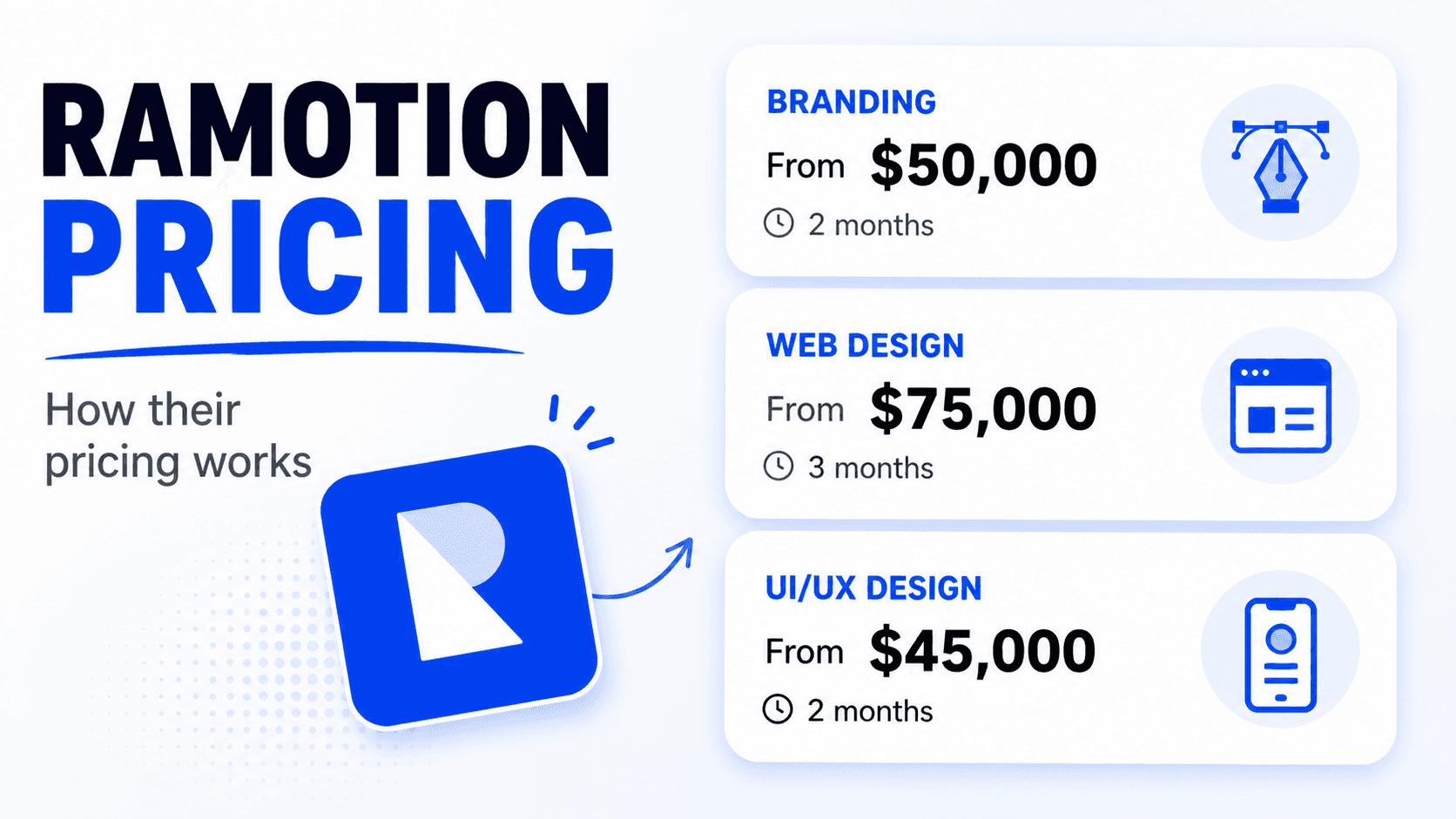
Ramotion does not appear to publish one simple fixed pricing page for every type of project. So if you are seriously considering hiring them, you should request a custom quote based on your project scope.
But public pricing data gives us a good idea of the range.
Clutch lists Ramotion with a $50,000+ minimum project size and a $150–$199 hourly rate. It also lists the agency as having 10–49 employees and being founded in 2009.
Clutch’s pricing summary says Ramotion’s reviewed project costs range from $12,000 to over $150,000, depending on scope. It also says clients appreciate the value for cost because of high-quality designs and strong communication, although some clients wanted more competitive pricing and faster delivery.
DesignRush gives a slightly different public company snapshot. It lists Ramotion with 50–99 employees, an average hourly rate of $150/hour, and a founding year of 2011.
So, there is a small difference between sources on employee count and founding year. Ramotion’s own About page says the studio has 70 team experts, has been in the industry since 2009, and has completed 350+ projects.
My honest pricing take is this:
Ramotion is not a low-budget studio.
If you are an early founder with a $2,000 design budget, Ramotion is probably not the right fit. If you only need a simple landing page to test an idea, this may be more agency than you need.
But if you are a funded startup or tech company trying to build a serious brand system, marketing site, product UI, and design language, Ramotion’s pricing becomes easier to understand.
You are not just paying for a few screens. You are paying for brand thinking, product thinking, design consistency, and a team that has worked with recognizable tech companies.
What Do You Get With Ramotion?
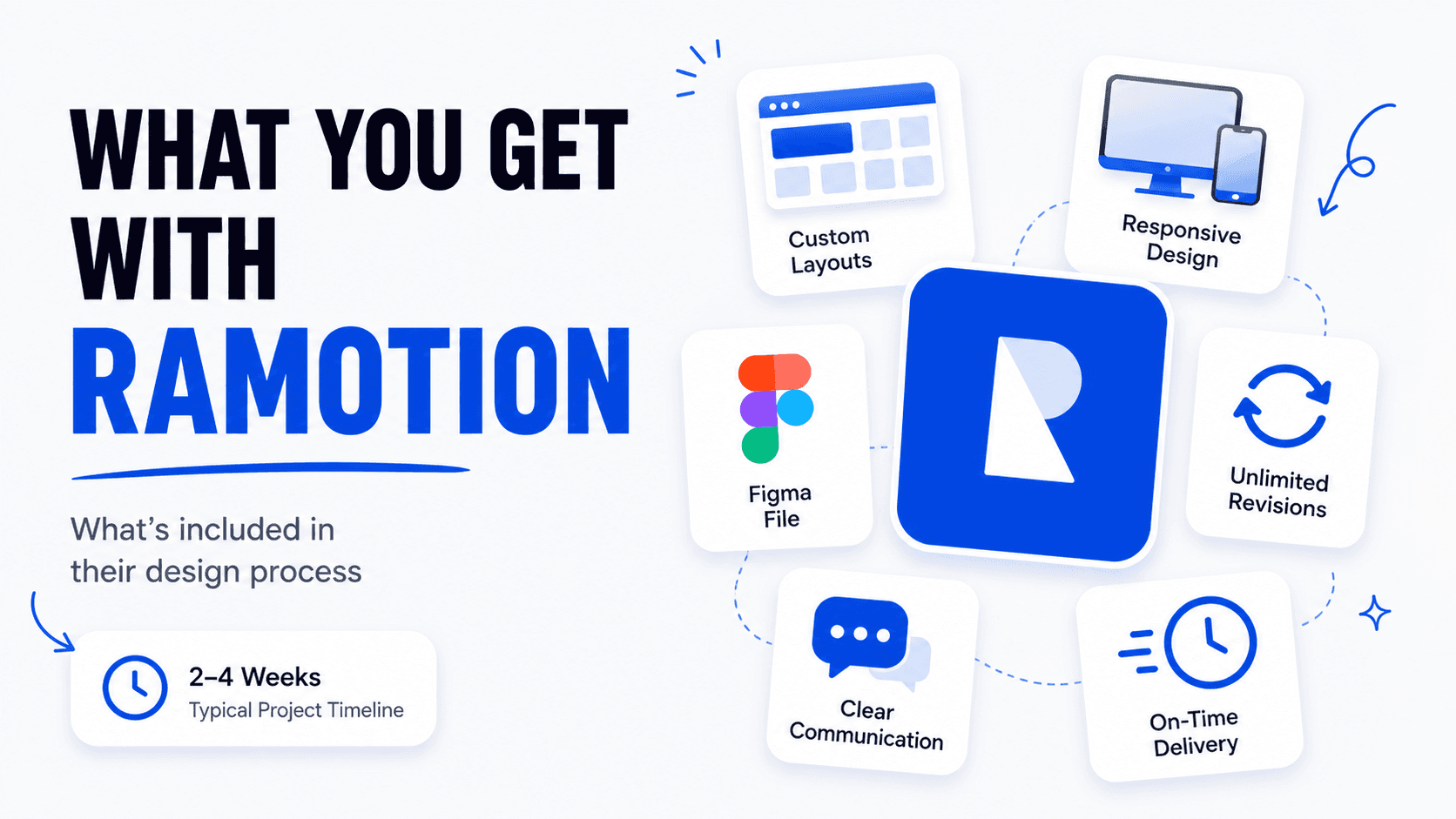
What you get with Ramotion depends on the scope, but their public service pages make the general offer clear.
Ramotion’s core service areas include branding, web design, UX design, design systems, app design, and web app development. Their website also includes specific service pages for SaaS branding, SaaS web design, SaaS UX design, startup branding, startup web design, B2B branding, B2B web design, and B2B UX design.
If you hire Ramotion for branding, you may get brand strategy, brand identity, rebranding, logo work, visual systems, iconography, and brand assets.
If you hire them for web design, you may get a marketing website, SaaS website, landing page system, UX structure, UI design, responsive layouts, SEO-aware design, and development support.
If you hire them for product design, you may get UI/UX design, app design, dashboards, product flows, interface systems, design systems, prototypes, and product visuals.
Their SaaS UX page says Ramotion delivers research-driven design for SaaS platforms, combining usability, interaction, and visual design to create accessible digital experiences.
Their SaaS web design page says they create high-performing web designs that integrate UI/UX, intuitive functionality, and SEO to improve user experience and drive conversions.
That is exactly why Ramotion makes sense for SaaS companies. SaaS design is not only about one beautiful homepage. It is about making the whole experience feel trustworthy, clear, and scalable.
What Are Ramotion’s Biggest Strengths?
Ramotion’s biggest strength is consistency across brand and product.
A lot of startups treat brand and product as separate things. They hire one person for the logo, another person for the website, another person for the app interface, and another person for marketing assets. The result can feel messy.
Ramotion seems built to solve that problem. Their website says they work at the intersection of product and brand and help extend a consistent experience across touchpoints.
The second big strength is SaaS and tech relevance.
Ramotion has dedicated public service pages for SaaS branding, SaaS web design, SaaS UX design, B2B branding, B2B web design, cybersecurity branding, fintech branding, healthcare branding, startup branding, and startup UX design.
The third strength is public proof.
Ramotion’s official portfolio includes projects or public case study mentions connected to Adobe, Crunchbase, Opera, Redis, Okta, Cellebrite, Turo, Citrix, Cypress, Descript, Clearbit, Streamlit, Filecoin, Xero, HealthTap, Salesforce, Rizzle, Firefox, Holidu, and more.
The fourth strength is review quality.
Clutch lists Ramotion with a 4.9 overall rating from 29 reviews, with top mentions including high-quality work, communication, timeliness, well-organized projects, collaboration, flexibility, project management, and unique expertise.
The fifth strength is that clients often seem to treat Ramotion like an extension of their internal team. Clutch’s review insights say Ramotion builds strong collaborative relationships and is often seen as an extension of the client’s team.
That is valuable for startups because design is rarely a one-time task. A good design partner needs to understand the company, keep context, and support the product as it evolves.
My Honest Design Opinion
My honest design opinion is that Ramotion is a strong fit for companies that care about system-level design.
Some studios are better at one viral homepage. Some are better at wild motion. Some are better at beautiful illustrations.
Ramotion feels more useful when the company needs a complete design language.
That is why the phrase “strong design systems for startups and tech companies” fits them well.
A startup does not only need a logo. It needs a visual language that can work across the website, product UI, pitch deck, social assets, app store screens, emails, sales materials, dashboard, icons, and future product pages.
If all of those touchpoints feel different, the company feels less mature.
Ramotion’s work seems strongest when the goal is to make the whole company feel more coherent. Their client examples around Salesforce Lightning Design System micro-interactions, Xero UI prototyping, Firefox identity, Cypress rebrand, and Rizzle brand/product redesign all point toward that broader system-level capability.
But I would not say Ramotion is right for every founder.
If you just need a fast, affordable landing page, you may not need this level of brand/product design. If you are still validating your idea, a smaller studio or freelancer may be enough. If your main goal is paid-ad CRO testing, you may want a conversion-focused landing page agency.
Ramotion makes the most sense when design consistency is tied to business growth.
If your product has traction, your team is growing, your marketing site needs to look more mature, and your product UI needs to feel more trustworthy, then Ramotion is worth a serious look.
Pros of Hiring Ramotion
The first pro is that Ramotion understands both brand and product.
This is very useful for tech companies because the brand cannot stop at the homepage. The product experience also has to feel consistent.
The second pro is that Ramotion has strong SaaS and B2B relevance.
Their public service pages directly mention SaaS branding, SaaS UX, SaaS web design, B2B branding, B2B web design, and startup design services.
The third pro is that Ramotion has strong public reviews.
A 4.9 Clutch rating from 29 reviews is a solid signal, especially when review themes include high-quality work, communication, collaboration, flexibility, and project management.
The fourth pro is that Ramotion has worked with recognizable brands and tech companies.
Their public site mentions projects connected to Adobe, Crunchbase, Opera, Redis, Okta, Turo, Citrix, Cypress, Descript, Clearbit, Streamlit, Filecoin, Xero, HealthTap, Salesforce, Firefox, and others.
The fifth pro is that Ramotion appears strong for long-term design support.
Their About page includes a testimonial from Kevin Sproles, Founder and CEO at Volusion, saying Ramotion became an extension of their Product Design and Research team and consistently delivered high-quality design under tight deadlines.
The sixth pro is that Ramotion seems comfortable working with complex product categories.
Their portfolio filters include AI, B2B, SaaS, fintech, security, healthcare, IoT, and dev tools.
Cons of Hiring Ramotion
The first con is price.
Ramotion is not cheap. Clutch lists a $50,000+ minimum project size and a $150–$199 hourly rate. That will be outside the range of many bootstrapped founders and early-stage startups.
The second con is that delivery pace may need to be discussed upfront.
Clutch’s review insights say some clients experienced project delays or noted a slower delivery pace, even though the work quality was generally high.
The third con is that public pricing is not simple.
You will likely need to contact Ramotion for a custom quote, and public sources show different snapshots across Clutch, DesignRush, and Ramotion’s own website.
The fourth con is that Ramotion may be too much for small projects.
If you only need one landing page, one app screen, or a simple logo, you may not need a full product-and-brand agency.
The fifth con is that Ramotion is not mainly positioned as a pure CRO agency.
They do mention conversions and high-performing SaaS web design, but their main public positioning is broader: branding, product design, UX/UI, web design, design systems, and digital product work.
So, if your main goal is paid traffic performance, A/B testing, heatmaps, and analytics-led iteration, you should ask very specific questions about how Ramotion handles conversion work.
Who Should Hire Ramotion?
You should consider hiring Ramotion if you are a SaaS company that needs a stronger brand and product visual system.
Ramotion is also a good fit for funded startups that have outgrown their early design and now need something more mature.
You should also consider them if your product UI, website, and brand identity feel disconnected. This is a common problem for startups after a few years of fast growth. The company keeps adding pages, product features, sales materials, and marketing campaigns, but the design system does not keep up.
Ramotion can also make sense if you are in a complex B2B category. For example, fintech, cybersecurity, healthcare, AI, dev tools, and enterprise software usually need clear design to make the product feel trustworthy.
You should also consider Ramotion if you want an external team that can support ongoing brand and product design needs, not just one isolated project.
In simple terms, Ramotion is a good fit when you need your company to look more mature, more consistent, and more credible across every digital touchpoint.
Who Should Not Hire Ramotion?
You probably should not hire Ramotion if your budget is very small.
You should also avoid Ramotion if you only need a quick website, a simple five-section landing page, or a cheap logo.
If you are still validating an idea, Ramotion may be too expensive for your current stage. You may be better off with a lean landing page, simple brand identity, and fast user testing.
Ramotion may also not be the best fit if your main problem is copywriting or paid ads. They can support websites and UX, but if your real issue is positioning, offer strategy, paid traffic, or conversion testing, you may need a growth or CRO specialist.
You should also be careful if you need an extremely fast turnaround. Since some reviews mention pace and project delays, it is worth confirming timeline, milestones, team size, feedback process, and delivery expectations before signing.
Ramotion Alternatives
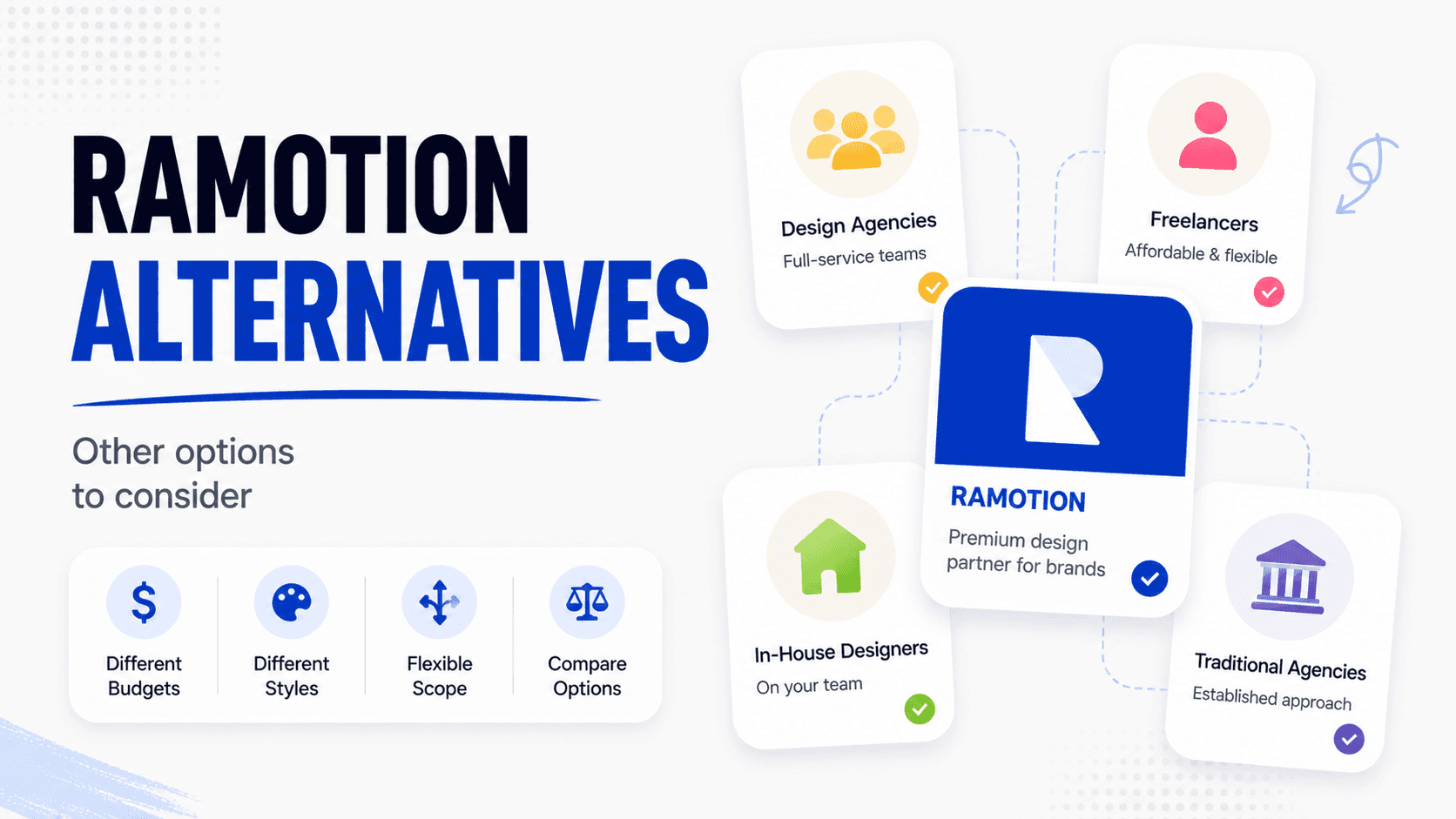
If Ramotion feels too expensive or too advanced for your current stage, there are a few alternatives worth considering.
A freelance brand designer may be enough if you only need an early logo, color system, or visual direction.
A smaller SaaS design studio may be better if you want strong design quality but do not have a $50,000+ budget.
A Webflow specialist may be a better choice if you already have branding and copy and only need a clean marketing site built quickly.
A Framer specialist may work well if you want a modern startup landing page with a faster launch timeline.
A product design studio may be better if your biggest challenge is user flows, dashboards, onboarding, and app UX rather than brand identity.
A CRO-focused landing page agency may be better if your main goal is paid traffic conversion, A/B testing, and funnel optimization.
An in-house designer may make sense if your company needs constant design support every week across product, brand, and marketing.
And if your budget is lower than Ramotion but you still want clean, conversion-focused design, you can also check our Work.
Landing Page Design
From $250–$500/page
Figma design for landing pages, service pages, and campaign pages.
Features include:
Custom Figma landing page design
Clear section structure and page flow
Responsive design thinking for desktop and mobile
Conversion-focused layout and visual hierarchy
Final Figma file included
Framer / Webflow Development
From $200–$300/page
Responsive build, basic SEO setup, CMS when needed, clean handoff.
Features include:
Framer or Webflow page development
Responsive setup for desktop, tablet, and mobile
Smooth interactions and basic animations
CMS setup when needed
Basic SEO structure and clean page setup
Final handoff after launch
Design + Build Package
From $700+
Best for people who want the page designed and developed together.
Features include:
Full landing page design in Figma
Framer or Webflow development included
Content structure and section planning
Responsive design and development
Basic SEO setup before launch
End-to-end support from idea to live website
Pitch Deck Design
From $30/slide
For startup decks, sales decks, and client-facing presentations.
Pricing breakdown:
Custom pitch deck slide design
Clean visual layout and storytelling
Investor, sales, or client presentation format
Charts, icons, and content formatting
Brand-consistent design direction
Editable final deck file
Small Updates
From $20/update
For existing clients who need minor design or website changes.
Pricing breakdown:
Small website text or image updates
Minor Figma design changes
Section spacing and layout adjustments
Simple Framer or Webflow edits
Quick turnaround for existing clients
I run a design and web studio where we help startups, founders, and agencies with:
Landing page design
Website design
Figma UI design
Webflow development
Framer development
White-label design support for agencies
The difference is that we are usually a better fit for people who want strong design and execution but may not be ready to spend $50,000+ on a premium agency engagement.
So if Ramotion feels like the right level of quality but the pricing is outside your current budget, you can look at smaller studios like ours as an alternative.
Of course, this does not mean Ramotion is bad. It just means every business has a different budget, timeline, and design need.
Final Verdict: Is Ramotion Worth It?
Ramotion is worth hiring if you are a startup or tech company that needs strong SaaS branding, product visuals, UI/UX, marketing site design, or a scalable design system.
The studio’s biggest strength is that it connects brand and product. That is very useful for SaaS companies because your brand does not only live on your homepage. It also lives inside your product UI, onboarding, icons, dashboards, sales decks, help center, app screens, and marketing campaigns.
Ramotion’s public proof is also strong. Their official site shows a wide portfolio of tech and product work, their Clutch profile shows a 4.9 rating from 29 reviews, and their own reviews page lists average ratings of 5.0 on Google, 4.9 on Clutch, and 4.9 on DesignRush.
But Ramotion is not for every founder.
If you need a cheap website, fast MVP landing page, or small one-off design task, you should probably compare smaller options first. Ramotion makes the most sense when your design needs are bigger than one screen or one page.
My final recommendation is simple:
Hire Ramotion if you want a serious product-and-brand design partner for a SaaS, startup, or tech company. Compare alternatives if your budget is smaller, your timeline is very tight, or your project only needs basic execution.