Design Studio Review
Designjoy Review 2026: Pricing, Services, Pros, Cons & Is It Worth Hiring?
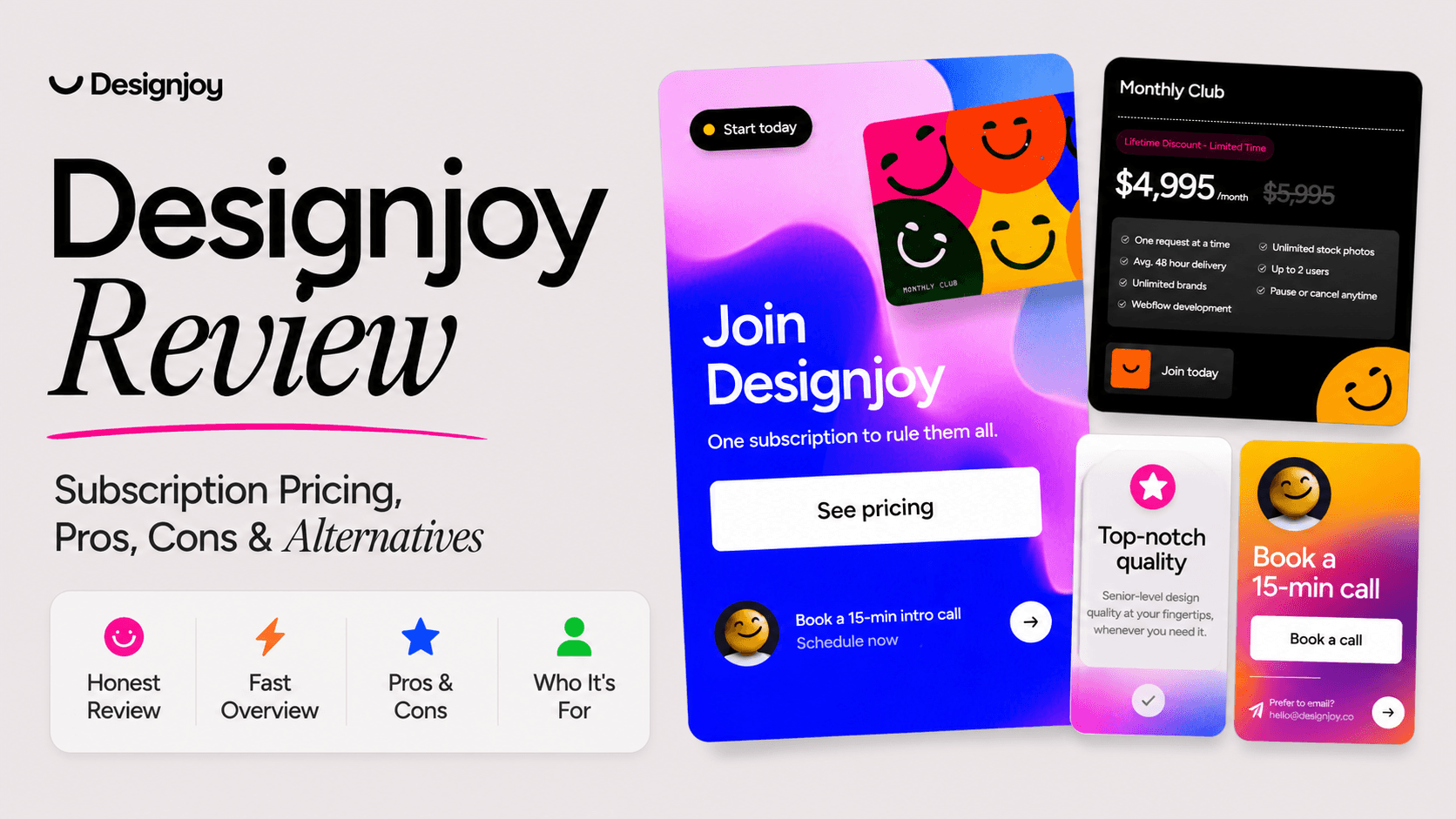
Read this Designjoy review covering pricing, services, client reviews, pros, cons, alternatives, and whether Designjoy is worth hiring for design.
Limited Monthly Offer
Unlimited Requests
Design + Development
Animations Included
Fixed Monthly Price
Introduction
If you are searching for a Designjoy review, you are probably not looking for a basic company profile.
You are probably asking one simple question: Should I hire Designjoy or not?
That is what I want to help you decide in this article.
My honest view is this: Designjoy is worth considering if you want a premium design subscription, have ongoing design needs, and can afford a high monthly design budget. But I would not say it is the best fit for everyone.
Designjoy has a clear offer, public pricing, a well-known founder, and a strong productized service story. At the same time, it is expensive, public review data is limited, and the one-person model can raise fair questions around capacity and consistency. On Designjoy’s official website, the studio says it was first launched in 2017, is run entirely by Brett, does not hire extra designers, and does not outsource work.
So let us break down Designjoy’s pricing, services, reviews, pros, cons, and alternatives clearly.
Quick Verdict: Is Designjoy Worth Hiring?
Quick verdict: Yes, Designjoy is worth considering if you need ongoing design work, like async communication, and want a simple monthly design subscription instead of hiring a freelancer, agency, or full-time designer. It is best for startups, SaaS teams, creators, and marketing teams with regular design needs. But it may not be ideal if your budget is low, you need deep UX research, or you expect multiple designers working on different requests at the same time.
Question | Quick answer |
Is Designjoy legit? | Yes, based on its public website, pricing, founder presence, public interviews, and visible service process. |
Best for | Startups, SaaS teams, founders, creators, and companies with ongoing design needs. |
Not best for | Low-budget founders, basic one-page sites, deep research-heavy UX work, or teams wanting a full agency team. |
Pricing signal | At the time of writing, Designjoy’s pricing section lists its Monthly Club at $4,995/month, with $5,995/month also shown nearby as a higher or previous listed price. |
Main risk | The model is simple and fast, but buyers should confirm output expectations, quality fit, queue limits, and public review signals before subscribing. |
Designjoy’s pricing section lists one request at a time, average 48-hour delivery, unlimited brands, Webflow development, unlimited stock photos, up to 2 users, and pause/cancel anytime.
My simple take: Designjoy can be a strong option for the right buyer, but I would not subscribe casually. At this price point, you should know exactly what you need, how the queue works, and what kind of output you can realistically expect.
How I Reviewed Designjoy
I reviewed Designjoy based on public research and professional design analysis. I looked at Designjoy’s official website, public pricing, FAQ details, public review signals, founder interviews, service clarity, buyer fit, design positioning, and possible risks for different types of clients.
I have not personally hired Designjoy. So this review is based on public information, not private client experience.
Criteria | Score | My view |
Service clarity | 9/10 | The offer is very easy to understand: subscribe, add requests, receive designs through a queue. |
Pricing clarity | 8/10 | Pricing is public, which is helpful. Buyers still need to understand what “one request at a time” means. |
Visual/design quality | 8/10 | The website, brand, and offer are polished and productized well. |
Public reputation | 6/10 | Strong founder visibility, but third-party public review volume is limited. |
Budget accessibility | 4/10 | Expensive for bootstrapped founders and small businesses. |
Buyer fit | 7.5/10 | Strong for ongoing design needs, weaker for one-off basic projects or research-heavy UX work. |
The goal here is not to fake precision. The goal is to give a useful buyer-focused view. When public data is limited, I will say it clearly.
What Is Designjoy?
Designjoy is a design subscription service.
Instead of hiring a freelancer, traditional agency, or full-time designer, you pay a monthly fee and submit design requests through a queue.
On Designjoy’s website, the process is explained simply: subscribe to a plan, request as many designs as you want, and receive designs within two business days on average. The site lists request types like mobile apps, presentations, logos, social media, email, Webflow, print design, packaging, ad creative, landing pages, branding, display ads, and user interface design.
If I had to explain Designjoy simply, I would say: Designjoy is a premium, founder-led design subscription for companies that need ongoing design output without hiring in-house or managing a traditional agency.
The unique part is the one-person model. Designjoy says it is run entirely by Brett, does not hire extra designers, and does not outsource work.
That is also why people talk about Designjoy so much. Some people admire the model because it is lean, simple, and profitable. Others question whether one person can realistically deliver premium work for many clients while keeping speed and quality consistent. Both reactions are understandable.
Is Designjoy Legit?
Yes, from what I could verify publicly, Designjoy does look legit.
It has a live official website, public pricing, a clear subscription model, a named founder, a visible request process, public interviews, and public third-party discussion.
The Futur’s episode page with Brett Williams describes Brett as a designer and entrepreneur who runs DesignJoy, a design subscription service, and says he operates as a one-man design agency at scale.
Product Growth’s 2025 episode/article on Brett from Designjoy also describes the business as a one-person operation built around a Trello board, no team, and no meetings.
So I would not frame the question as “Is Designjoy real?”
The better question is: Is Designjoy the right fit for your project, budget, and expectations?
That answer depends on what you need.
Designjoy Services Explained
Designjoy covers a broad range of design work. That is one of the strongest parts of the offer.
Service | What it means for the client |
Website design | Design for marketing websites, landing pages, and web pages. |
Landing page design | Conversion-focused pages for launches, campaigns, SaaS, ads, or lead generation. |
UI/UX design | Interface design for apps, dashboards, SaaS products, or mobile products. |
Branding | Logo, visual identity, brand direction, and brand guide style work. |
Slide decks | Presentation design for sales, fundraising, or internal use. |
Social media and ads | Marketing creatives, display ads, social posts, and campaign graphics. |
Webflow development | Turning design into Webflow pages when the project fits Webflow. |
Email design | Visual design for email campaigns or branded email assets. |
Print and packaging | Offline assets, print materials, and some packaging-related work. |
The Designjoy services/recent work section lists web design, logos, slide decks, branding, social media, UI/UX design, Webflow development, mobile apps, print design, email, display ads, icons, brand guides, and more.
This makes Designjoy useful for companies with mixed design needs. For example, one month you may need a landing page. The next month you may need ad creatives, a deck, UI screens, and a Webflow page.
That is where the subscription model can make sense.
But there is one important limit: Designjoy works one request at a time. Their pricing section lists “one request at a time,” and the FAQ says clients can add as many requests as they want, but those requests are delivered one by one.
So “unlimited requests” does not mean unlimited output at the same time. It means unlimited queue. That difference matters.
Designjoy Pricing
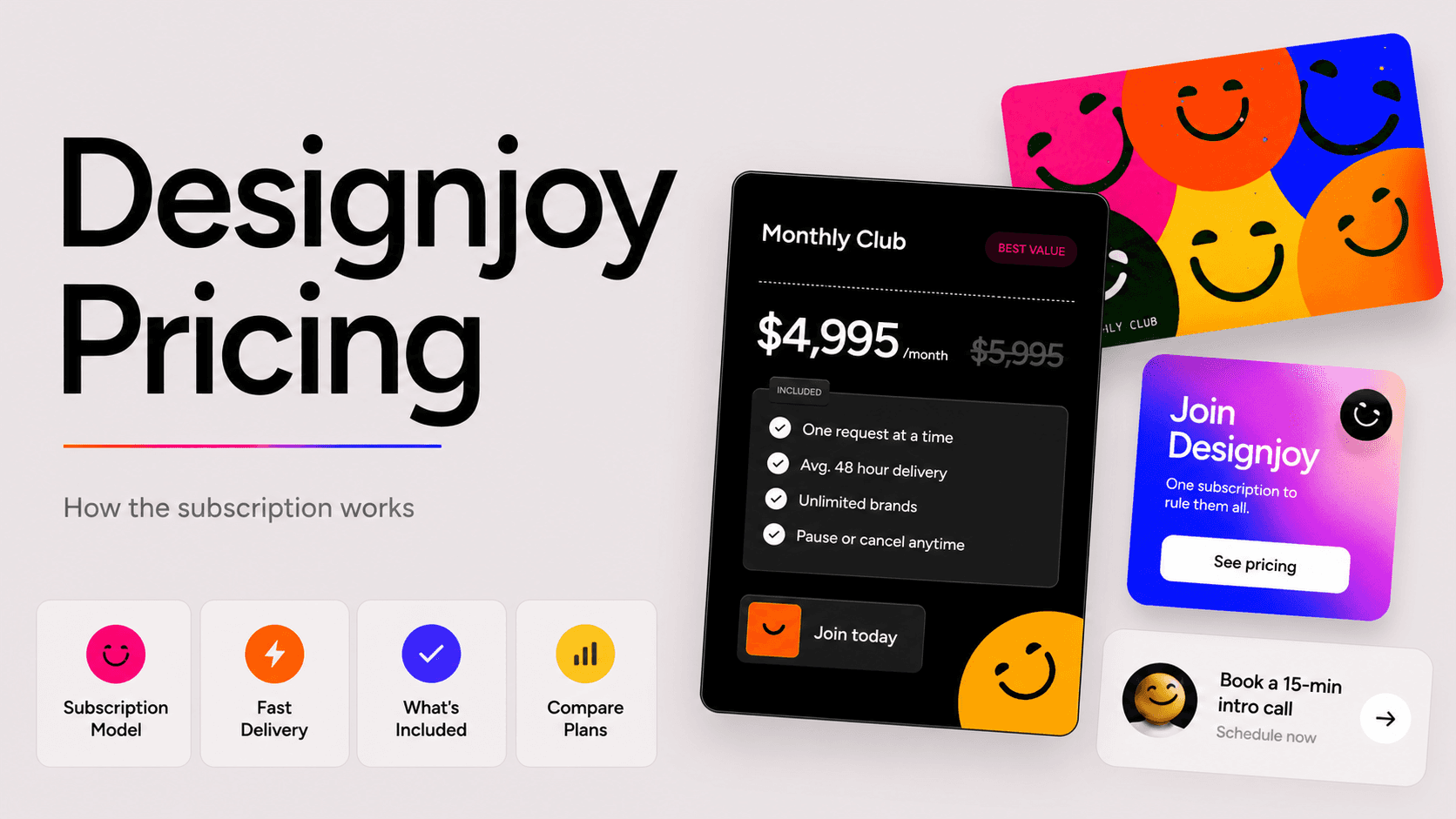
At the time of writing, Designjoy’s pricing section lists the Monthly Club plan at $4,995/month. The same pricing area also shows $5,995/month, which appears as a higher or previous listed price beside the current offer. The plan includes one request at a time, average 48-hour delivery, unlimited brands, Webflow development, unlimited stock photos, up to 2 users, and pause/cancel anytime.
Last checked: May 4, 2026.
Plan | Public price at time of writing | What is listed |
Monthly Club | $4,995/month | One request at a time, average 48-hour delivery, unlimited brands, Webflow development, unlimited stock photos, up to 2 users, pause/cancel anytime. |
Higher/previous listed price | $5,995/month | Shown near the current Monthly Club price. |
So no, Designjoy is not a cheap design option.
At around $5,000 per month, it is mainly for companies that already have a serious design budget.
If you are a funded startup, SaaS team, or marketing team with constant design needs, that price may still make sense. Hiring a senior full-time designer in the US can be much more expensive when you include salary, benefits, hiring time, management, and workload planning.
But if you are an early-stage founder who only needs one landing page, Designjoy may feel expensive.
Designjoy’s pause feature helps a little. The FAQ says clients can pause their subscription and keep unused days for later. For example, if someone uses 21 days and pauses, the remaining 10 days can be used in the future.
That is useful if your design needs come in bursts.
Still, my advice is simple: Do not buy Designjoy unless you have enough design work to justify the monthly fee.
What Do You Actually Get?
Based on Designjoy’s FAQ, you get access to a design workflow managed through Trello.
After subscribing, Designjoy says clients are added to their own Trello board, usually within about an hour. From there, clients can add requests and follow the workflow inside the board.
Feature / deliverable | Included? | Notes |
Trello request board | Yes | Used to manage design requests. |
One request at a time | Yes | Important for understanding output speed. |
Average 48-hour delivery | Yes | More complex requests can take longer. |
Figma design | Yes | Designjoy says most requests are designed using Figma. |
Webflow development | Yes | Listed in the plan and explained in the FAQ. |
Unlimited brands | Yes | Useful for agencies or multi-brand businesses. |
Unlimited stock photos | Yes | Listed in the plan. |
Up to 2 users | Yes | Listed in the plan. |
Pause or cancel anytime | Yes | Helpful if work is not constant. |
Direct founder execution | Yes | Designjoy says clients work directly with Brett. |
Designjoy says larger requests are broken down on its end, including full-scale website design, mobile app design, and UI/UX work. It also says clients should expect a reasonable amount of work every 24–48 hours until the larger request is complete.
The most important thing here is how the workflow feels. Designjoy is best if you already know what you want to request.
Design a landing page hero for this SaaS product.
Create a pricing section for this website.
Design three ad creatives.
Build this approved page in Webflow.
Create a sales deck using this copy.
It may not be the best fit if your request sounds like:
Help us figure out our entire product strategy.
Run customer research before design.
Create multiple complex product flows in parallel.
Give us a full agency team with project managers and workshops.
Designjoy is more of a productized design execution system than a traditional consulting agency. That can be perfect for some buyers and wrong for others.
Designjoy Client Reviews and Reputation
This is where I would be careful.
Designjoy has a strong founder story and a lot of public attention, but public third-party review data is limited.
At the time I checked, Designjoy’s Trustpilot profile showed 2 total reviews, a 3.3 rating, and an “Average” TrustScore label. Trustpilot also says it uses technology to protect platform integrity but does not fact-check specific review claims because reviews are user opinions.
So I would not overreact either way.
Two reviews are not enough to confidently say “Designjoy is amazing” or “Designjoy is bad.”
One Trustpilot review is negative and criticizes quality/value. One review is positive. But the sample size is too small to treat it as a full reputation picture.
The balanced view is this: Public review data for Designjoy is limited, so I would treat the portfolio, public process, founder presence, and direct sales conversation as stronger signals than review volume.
Before hiring Designjoy, I would ask:
Can I see recent work similar to my project?
What types of requests are you best at?
What counts as one request?
How do large requests get broken down?
What happens if I do not like the first design direction?
How many active clients do you usually manage?
Is Webflow development included for my exact scope?
How fast can I realistically expect work for complex pages?
These questions matter more than just reading a couple of public reviews.
Why Designjoy Is Polarizing Online
Designjoy is not just a design service. It is also a very talked-about business model.
Some people admire it because Brett built a high-revenue, one-person design business. Others question how one person can deliver fast work to multiple clients while keeping quality high.
This is a fair thing for buyers to think about.
The Futur’s interview page says Brett runs Designjoy as a one-man design agency that operates at scale and earns upwards of $1 million in annual revenue. It also says that making this type of subscription service work requires being good and fast.
Product Growth’s 2025 profile describes Brett as running a $2M/year one-person business and says the model is built around fixed pricing, one task at a time, fast turnaround, and no contracts.
That story is impressive. But for buyers, the important question is not just “Is the business impressive?” The important question is: Will this model work for my project?
A one-person model can be a strength because communication is direct. There are fewer layers. You know who is doing the work.
It can be a weakness if you need parallel execution, a full UX team, heavy strategy, lots of meetings, or multiple specialists working at the same time.
So I would not hire Designjoy only because the story is popular. I would hire Designjoy only if the actual workflow, output, pricing, and design style match what I need.
My Honest Design Opinion
My honest design opinion is that Designjoy is very strong at packaging.
The website is clean. The offer is clear. The pricing is visible. The process is simple. The positioning is memorable.
That alone makes Designjoy stand out.
A lot of design studios make the buying process confusing. You have to book a call, explain everything, wait for a custom proposal, and only then understand the price.
Designjoy removes a lot of that friction. From a positioning point of view, that is smart.
Design-wise, the brand feels modern, direct, and startup-friendly. It does not feel like a traditional corporate agency. It feels more like a product. That fits the subscription model well.
But I would still check recent work before hiring. Designjoy links to recent work from its website, and that is the kind of work sample I would inspect closely before subscribing. You can start from Designjoy’s official website.
Some productized services can become very system-driven. That is not always bad. A system can make delivery faster. But if your brand needs deep originality, serious UX discovery, custom art direction, or a full brand strategy process, you should make sure Designjoy’s style and workflow fit.
For landing pages, SaaS marketing pages, decks, UI screens, web visuals, and Webflow-style projects, Designjoy may be strong.
For deep enterprise UX, backend-heavy builds, complex research, or very custom brand systems, I would compare other options before subscribing.
Pros of Hiring Designjoy
Very clear offer
Designjoy is easy to understand. You subscribe, add requests, and receive designs through a queue.
Public pricing
Many agencies hide pricing. Designjoy shows pricing publicly, which helps buyers decide faster.
Fast average turnaround
Designjoy says most requests are completed in two business days or less on average, while more complex requests can take longer.
Broad design coverage
Designjoy covers websites, landing pages, UI/UX, branding, logos, decks, ads, emails, Webflow, and more.
Founder-led execution
Some buyers like knowing exactly who is doing the work. Designjoy says clients work directly with Brett through the entire experience.
Pause/cancel flexibility
The pause feature can help if your design workload is not constant every month.
Strong productized model
Designjoy’s system is simple, which can save time compared to a slow custom agency process.
Cons of Hiring Designjoy
It is expensive
At $4,995/month, Designjoy is not suitable for every founder or small business.
One request at a time can limit output
You can add many requests, but they are delivered one by one. This matters if you need multiple workstreams moving at once.
Public reviews are limited
Trustpilot currently shows only 2 total reviews for designjoy.co. That is not enough volume to judge the full client experience.
The one-person model may not fit every buyer
Some clients want a team with multiple designers, developers, project managers, and UX researchers.
Not ideal for deep UX research
Designjoy seems better suited to fast design execution than long research-heavy discovery projects.
Quality expectations must be aligned early
Because the service is premium-priced, buyers should ask for recent examples and clarify the expected quality level for their exact project.
It may not be the best choice for one-off small projects
If you only need one simple page, a project-based freelancer or smaller studio may make more financial sense.
Who Should Hire Designjoy?
Designjoy may be a good fit if:
You have ongoing design needs every month.
You can afford around $5,000/month.
You want fast async design execution.
You are comfortable using Trello.
You need landing pages, websites, UI screens, decks, ads, or Webflow support.
You do not want to hire a full-time designer.
You already know what you want designed.
You like the founder-led model.
I think Designjoy is especially interesting for SaaS companies, creator-led businesses, funded startups, and marketing teams that need steady design output.
Who Should Avoid Designjoy?
Designjoy may not be the best fit if:
Your budget is very low.
You only need a basic one-page website.
You want the cheapest possible designer.
You need deep UX research before design.
You need a full agency team.
You need backend development.
You expect multiple designers working at once.
You are not clear about your project goals yet.
You want lots of strategy calls and workshops.
This does not mean Designjoy is bad. It just means the model has a specific fit.
For some founders, it may be perfect. For others, it may be too expensive or too limited.
Best Designjoy Alternatives
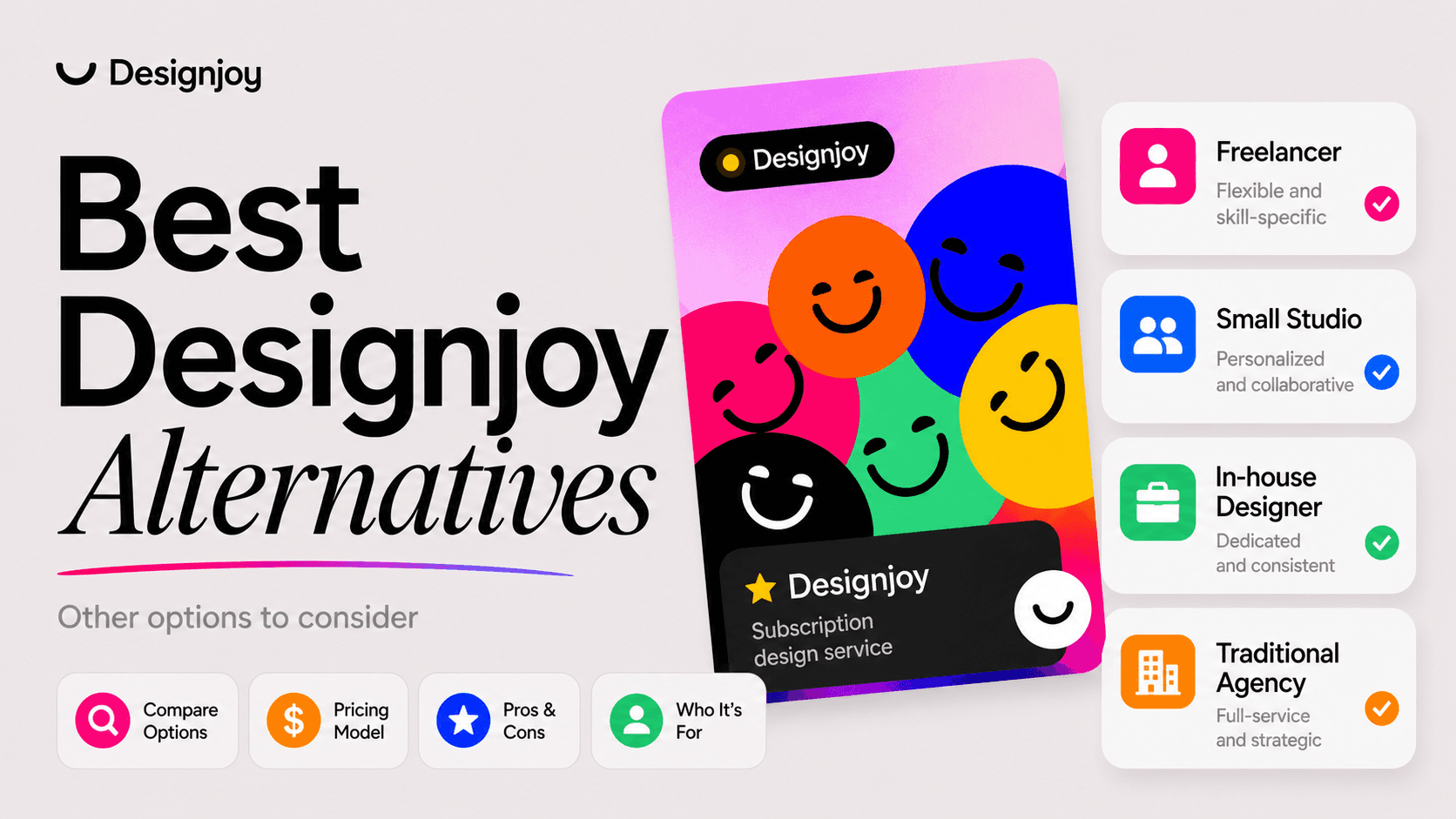
If you are comparing Designjoy alternatives, I would not only compare names. I would compare the type of support you actually need.
Alternative type | Best for | Why choose it instead |
Smaller design studio | Landing pages, websites, Webflow, Framer, and custom scopes. | More flexible and often more affordable than a premium subscription. |
Freelance designer | Early MVPs, simple websites, and smaller design tasks. | Lower cost and direct communication. |
Traditional agency | Larger companies that need strategy, workshops, and full-team support. | Better for complex projects with many stakeholders. |
Design subscription service | Ongoing marketing design and creative production. | Useful when you need regular design output every week. |
Webflow/Framer specialist | Teams that already have designs and need development. | Better if the main need is clean build execution. |
In-house designer | Companies with daily product/design needs. | More internal context and long-term ownership. |
Some named alternatives to compare include Design Pickle, Superside, ManyPixels, and Penji. Design Pickle describes itself as a creative-as-a-service platform for graphic design, motion, and illustration; Superside positions itself as a creative service built to scale alongside in-house teams; ManyPixels describes flat monthly pricing with unlimited design requests and revisions; and Penji lists monthly creative production plans on its pricing page.
Disclosure Before Mentioning Kedara
Disclosure: I run a smaller design and no-code studio, so I may include Kedara as a more flexible alternative where relevant. This does not mean Designjoy is bad. The goal of this review is to help you compare options honestly.
If you like Designjoy’s design-focused approach but want to compare a more flexible design and development partner, you can also check out Kedara.
Kedara works with startups, founders, and agencies on:
Landing page design
Website design
Figma UI design
Webflow development
Framer development
White-label design support
Kedara may be a better fit if you want a leaner collaboration style, custom page-by-page scope, or ongoing design/development support instead of a fixed premium subscription.
Small pricing callout:
Service | Starting range |
Figma website / landing page design | $250-$500 per landing page, based on complexity |
Webflow / Framer / website development | $200-$300 per page |
Pitch deck design | $30 per slide |
Small ongoing support / minor updates | $20 per update after working with us |
Final pricing depends on scope, complexity, section count, and timeline.
So the choice is not simply “Designjoy vs Kedara.” The better question is: Do you need a premium monthly design subscription, or do you need a flexible project-based design and development partner?
Final Verdict: Is Designjoy Worth It?
My final view is simple.
Designjoy is worth considering if you have the budget, need ongoing design work, and like a fast async subscription model.
It has a clear offer, public pricing, a strong founder-led story, broad design coverage, and a simple request process.
But I would not say it is perfect for everyone.
The pricing is high. The public review volume is limited. The one-person model creates fair questions around capacity. And the one-request-at-a-time workflow may not fit teams that need multiple complex design projects moving at once.
Before hiring Designjoy, I would check:
Recent portfolio examples
Whether your project type fits their strengths
What counts as one request
How complex requests are handled
Expected output per month
Webflow scope and limitations
Revision process
Whether the subscription makes sense for your workload
If the portfolio matches your taste and the monthly cost fits your budget, Designjoy can be a strong option.
If the budget feels too high or you want a more flexible design/development partner, compare smaller studios, freelancers, Webflow/Framer specialists, or Kedara before making a final decision.
FAQ
Is Designjoy legit?
Yes, Designjoy appears to be legit based on its public website, founder presence, public pricing, visible service process, and public interviews. Buyers should still check recent work and confirm fit before subscribing.
Who founded Designjoy?
Designjoy is publicly associated with Brett Williams. Designjoy’s website says the service is run entirely by Brett and does not employ extra designers or outsource work.
How much does Designjoy cost?
At the time of writing, Designjoy lists its Monthly Club at $4,995/month, with $5,995/month also shown nearby as a higher or previous listed price. Pricing can change, so buyers should check Designjoy’s official pricing page before purchasing.
What services does Designjoy offer?
Designjoy offers website design, landing pages, UI/UX design, logos, branding, slide decks, social media graphics, email design, Webflow development, print design, display ads, icons, and brand guides.
Is Designjoy good for SaaS startups?
Yes, Designjoy can be a good fit for SaaS startups that need ongoing landing pages, UI screens, web design, decks, and marketing design. It may not be ideal for deep research-heavy UX projects.
Does Designjoy include Webflow development?
Yes, Designjoy lists Webflow development in its Monthly Club plan and says Webflow development is included with subscriptions when the website can be supported by Webflow.
What are the main risks of hiring Designjoy?
The main risks are high monthly pricing, one-request-at-a-time delivery, limited public review volume, and whether the one-person subscription model fits your expected output.
What are the best Designjoy alternatives?
The best Designjoy alternatives depend on your need. You can compare smaller design studios, freelancers, Webflow/Framer specialists, traditional agencies, in-house designers, or other design subscription services like Design Pickle, Superside, ManyPixels, and Penji.
Sources / References
Source note: Pricing, ratings, package details, review counts, and public claims can change over time. Always verify directly with the studio before making a hiring decision.