Design Studio Review
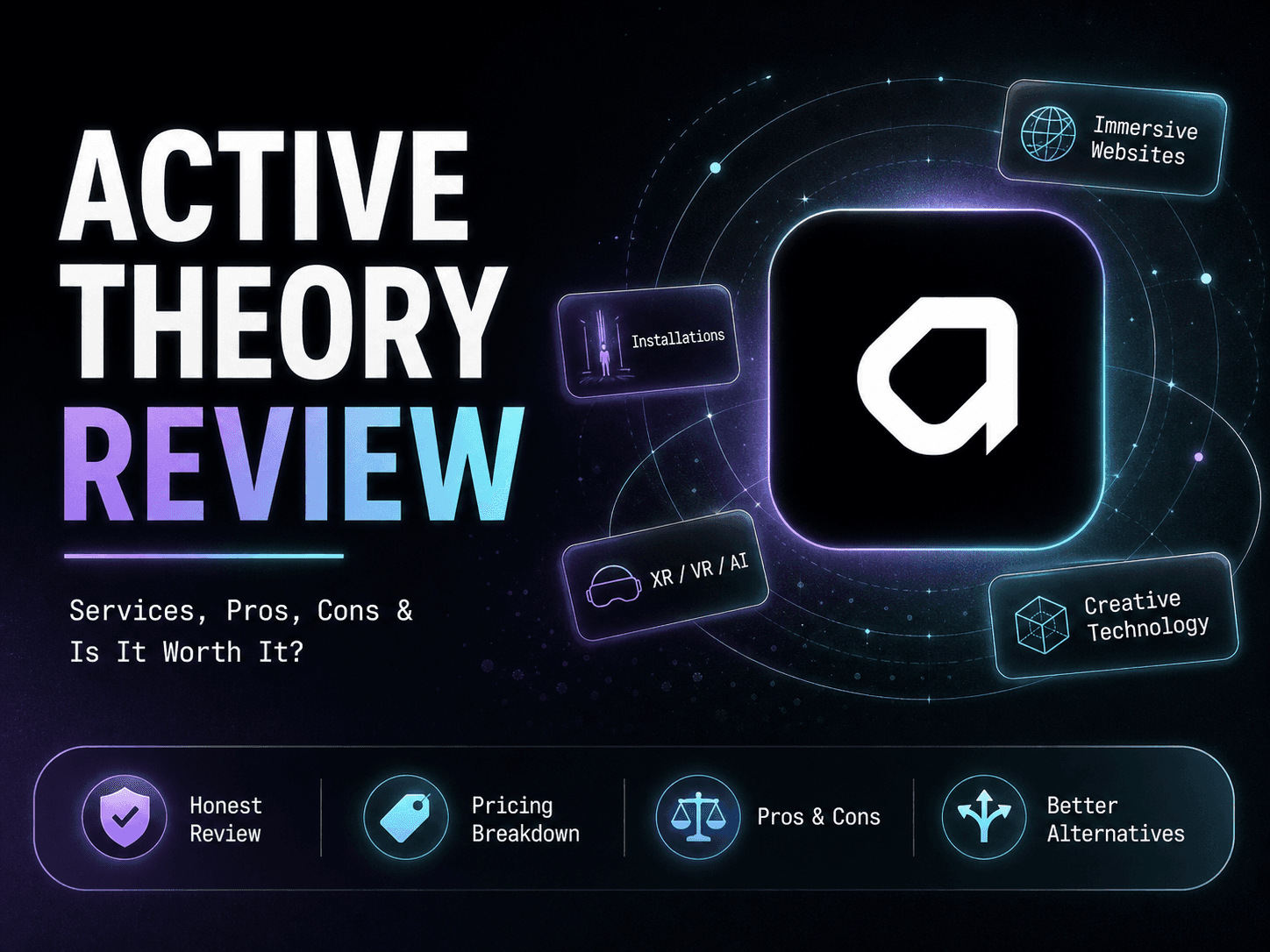
Active Theory Review 2026: Pricing, Services, Pros, Cons & Is It Worth Hiring?
Active Theory review: the LA creative tech studio behind Google I/O's Paper Planes and a 3D Hogwarts tour. Services, costs, pros, cons and alternatives.

Subarno Paul
Author
Designer & no-code developer
Introduction
Do you remember folding a paper plane on your phone, "throwing" it into the sky, and catching one thrown by a stranger on the other side of the world?
That was Paper Planes, a web experience made for Google I/O in 2016. People in more than 180 countries played it. It was simple, joyful and a bit magical, and it ran right in the browser.
It was made by Active Theory, a creative technology studio in Los Angeles that's spent more than a decade building experiences that feel more like games than websites.
If you're looking at Active Theory, you probably have a big idea: a launch, a campaign or an event that needs to make people say "wow." In this review, I'll walk you through who Active Theory is, what it does best, what it likely costs, and whether it's the right fit, or whether something simpler would do the job.
The Short Answer: Is Active Theory Worth It?
Active Theory is worth it for big brands that want playful, technically ambitious web, AR or event experiences, but it's not built for everyday websites or small budgets.
Question | Answer |
|---|---|
What is it? | A creative technology and interactive design studio |
Founded | 2012 |
Founders | Andy Thelander, Michael Anthony and Nick Mountford |
Location | Los Angeles, with a presence in Amsterdam |
Known for | Interactive web, 3D, AR, VR and games in the browser |
Famous clients | Google (Creative Lab and I/O), Pottermore |
Pricing | Not published |
How I Wrote This Review
I put this review together in early November 2026. I looked at an in-depth Communication Arts feature on the studio, its best-known public projects and its profiles across industry sites.
I haven't worked with Active Theory myself. I build websites with animation and interaction, so I'm looking at this as a designer who understands how much work goes into this kind of experience.
Who Is Active Theory?
Active Theory is a creative technology studio founded in the summer of 2012 by:
Andy Thelander, creative director,
Michael Anthony, interactive director,
Nick Mountford, managing director.
It's based in Los Angeles, in a two-story loft studio near Venice Beach, and it set up an office in Amsterdam to serve European clients.
What makes Active Theory different
Active Theory pairs design and software development in one studio. Many agencies design something and then hand it to developers. At Active Theory, designers and engineers work side by side, which is essential for interactive and 3D work.
It also builds its own tools. The studio created an in-house 3D toolset so designers can make and export 3D elements without as much hand-coding. That's one reason its experiences feel smooth and load fast.
Client work and lab work
Active Theory splits its time between client projects and experimental lab work. The lab is where it tests new ideas, like World Brush, an augmented reality app that lets people paint in real-world spaces. Many of those experiments later feed into client projects.
What Services Does Active Theory Offer?
Service | What it means | Example |
|---|---|---|
Interactive web experiences | Games and stories that run in the browser | A playable launch experience for a tech event |
3D and WebGL | Real-time 3D on websites | A 3D tour of a fictional world |
AR and VR | Augmented and virtual reality | An AR app that lets fans draw in space |
Event and conference experiences | Digital experiences for live events | Interactive moments for a developer conference |
Prototyping | Fast experiments to test ideas | Testing a new interaction before a pitch |
What it's not
Active Theory isn't a branding agency or a standard web design shop. If you need a logo, a marketing site or a CMS your team can update daily, you'll want a different partner.
Active Theory's Notable Projects
Active Theory's best-known work includes:
Racer (2013): a multiplayer racing game for mobile browsers built for Google, shown at Google I/O. You could line up several phones and race a car across all of them.
Paper Planes (2016): a web game for Google I/O, played by people in more than 180 countries.
Pottermore, 3D Hogwarts tour: a 3D web tour of Hogwarts for fans of the Harry Potter world.
World Brush: an AR app from its lab that lets people paint in real places.
It has worked repeatedly with Google Creative Lab and on Google I/O conferences.
What these projects show
The common thread is play and connection. Active Theory's best work invites people to interact with each other, not just watch. That's harder to build, and much more memorable.
What Do Clients Say About Active Theory?
Active Theory doesn't have a Clutch profile or a big set of Google reviews. Its reputation comes from its work and long relationships with clients like Google.
What strengths come through
Technical skill. Smooth, fast experiences on phones and browsers.
Play. Experiences people actually want to use.
Repeat clients. Several projects for Google over many years.
Innovation. A lab that keeps exploring new tech.
What's missing
There's little public detail about timelines, budgets and the working process. For a big project, ask for references.
Is Active Theory Legit?
Yes. Active Theory has been around since 2012, has built well-known projects for Google, and has been featured by Communication Arts and other industry publications.
How Much Does Active Theory Cost?
Active Theory doesn't publish prices. Here's my honest estimate, based on how studios doing this kind of work usually price. These are my own ranges:
Project type | What it usually involves | Rough budget (my estimate) |
|---|---|---|
Interactive campaign site | Concept, 3D, development, testing | High five figures to six figures |
Event or conference experience | Interactive pieces for a live event | Six figures |
AR or VR experience | App or web AR, 3D content, testing | Six figures and up |
Why it costs this much
Interactive experiences need concept artists, 3D designers, creative developers, sound and testing on many devices. Making something work smoothly on millions of different phones is one of the hardest parts, and the most expensive.
A worked example
Say you're launching a new phone and want people to "play" with it online before it's in stores.
A studio like Active Theory might:
Concept and prototype (3 to 4 weeks): test a few playful ideas quickly.
3D production (4 to 6 weeks): build the phone model and the world around it.
Development (6 to 8 weeks): build the experience to run on any phone browser.
Testing and launch (2 weeks): performance tuning and analytics.
That's about 3 to 5 months, likely in six figures. The payoff is a launch people share, not just scroll past.
Active Theory vs Other Interactive Studios
Active Theory is often compared with Lusion, Immersive Garden, Resn, Merci-Michel and North Kingdom.
Immersive Garden leans toward luxury and polished campaign sites.
Lusion is known for bold real-time 3D.
Resn and Merci-Michel lean playful and experimental.
North Kingdom is known for story-driven digital experiences.
Active Theory stands out for multiplayer, game-like experiences, event work and a strong AR/VR lab.
My Honest Design Opinion
As a designer, I love what Active Theory makes. Paper Planes is one of those projects that reminds you the web can be fun, not just useful.
My honest caution: these experiences are great for moments, not for every day. A playful 3D experience can be the highlight of a launch, but it shouldn't replace a clear, fast website that explains your product. Plan both.
Also, ask what happens after the campaign. Experiences like this often have a short life. Make sure you know how long it will be hosted and what it costs to keep it running.
Pros of Active Theory
Exceptional technical craft.
Playful, social experiences.
Design and engineering together.
Long Google relationship.
AR and VR expertise.
Cons of Active Theory
No public pricing.
High budgets.
Few public client reviews.
Not for everyday websites.
Campaigns have a short shelf life.
Who Should Hire Active Theory?
Active Theory is a good fit for:
big tech and consumer brands planning a launch,
conferences and events that want interactive moments,
brands exploring AR or VR,
marketing teams that want something people will share.
Who Should Look Elsewhere?
Look elsewhere if you:
need a marketing website or brand identity,
have a budget under six figures,
need something your team can update daily,
care most about SEO and page speed,
need ongoing, small design tasks.
Questions to Ask Before You Sign
"What's the realistic budget for what we've described?"
"How will it perform on older phones?"
"How long will it be live, and what does hosting cost?"
"Who on your team will lead our project?"
"Can we speak to a recent client?"
"Can any of it be reused after the campaign?"
Best Active Theory Alternatives
These aren't ranked. Most are interactive and creative tech studios, and I've also included myself.
Studio | Good at | Pick it if... |
|---|---|---|
Subarno Paul (that's me) | Websites with light animation in Framer or Webflow | You want a polished, fast site with tasteful motion |
Real-time 3D and WebGL | You want bold 3D on the web | |
Luxury immersive web | You're a premium brand | |
Experimental interactive campaigns | You want something surprising | |
Playful, game-like experiences | You want a fun, lighter tone | |
Story-driven digital experiences | You want narrative-led work |
A Quick Note About Me
I'm Subarno, and I run a small design and no-code studio. I can't build a multiplayer 3D experience for Google I/O, and I won't pretend I can.
What I can do is the part every campaign still needs: a clean, fast website that explains the product, with small, tasteful animations that make it feel alive. My $1,000/month retainer covers:
website design in Figma,
website builds in Framer or Webflow,
branding for smaller businesses, like logos, colors and brand guides,
small website animations and interactions,
banners, posters and social media content.
I also work white-label for agencies, so I can sit alongside a bigger creative partner. If that sounds useful, book a free 30-minute call or reach me on my contact page. If you want something people will play with and share, Active Theory is one of the best.
Final Verdict: Is Active Theory Worth It?
Active Theory has built some of the most loved interactive experiences on the web, from Google's Paper Planes to a 3D Hogwarts. Its mix of design, engineering and experimentation is rare.
It's worth it if you're a big brand with a launch or event that deserves something special, and the budget to match. For everyday websites, brand identities or small budgets, a simpler partner will serve you better.
FAQ
What is Active Theory?
Active Theory is a creative technology studio in Los Angeles that builds interactive web, 3D, AR and VR experiences.
When was Active Theory founded?
In the summer of 2012, by Andy Thelander, Michael Anthony and Nick Mountford.
What has Active Theory made?
Google I/O experiences like Racer (2013) and Paper Planes (2016), a 3D Hogwarts tour for Pottermore, and the World Brush AR app.
Who are Active Theory's clients?
Google (including Creative Lab and Google I/O) and Pottermore, among others.
Where is Active Theory based?
Los Angeles, with an office set up in Amsterdam for European clients.
How much does Active Theory cost?
It doesn't publish prices. Expect high five figures to six figures for interactive campaigns.
Does Active Theory do AR and VR?
Yes. It has explored AR and VR, including Magic Leap.
Is Active Theory good for a normal website?
Its strength is interactive campaigns. For an everyday website, a simpler studio is usually a better fit.
What are good alternatives to Active Theory?
Lusion, Immersive Garden, Resn, Merci-Michel and North Kingdom. For a polished website, my $1,000/month retainer is another option.
Sources
Details can change over time. Always confirm directly with the studio before you hire.
Limited Monthly Offer

