Design Studio Review
Fieldwork Review 2026: Pricing, Services, Pros, Cons & Is It Worth Hiring?
Read this Fieldwork review covering pricing signals, services, buyer fit, pros, cons, alternatives, and whether Fieldwork is worth hiring for design.
Limited Monthly Offer
Unlimited Requests
Design + Development
Animations Included
Fixed Monthly Price
Introduction
If you are searching for a Fieldwork review, you are probably trying to understand whether this Manchester design and technology studio is still a strong option for brand and digital product work.
You are probably asking one simple question: Should I hire Fieldwork for a brand, digital product, or service design project?
That is what I want to help you decide in this article.
My honest view is this: Fieldwork is worth considering if you need a Manchester design and technology studio for brands, digital products, and services. But I would not say it is the best fit for everyone.
Fieldwork describes itself as a design and technology studio that builds brands, digital products, and services centred around the people who use them. Fieldwork official website
At the same time, a public listing or official website is only one part of the buying decision. You still need to understand pricing, delivery model, service depth, portfolio quality, review signals, and whether Fieldwork fits your budget and stage.
So let us break down Fieldwork pricing, services, reviews, pros, cons, and alternatives clearly.
Quick Verdict: Is Fieldwork Worth Hiring?
Quick verdict: Yes, Fieldwork is worth considering if you are organisations that want a thoughtful studio for brand, digital product, service design, and people-centred technology work. It is not the best choice if you are buyers who want public fixed pricing, a fast productized landing page, or a Framer-only specialist.
Question | Quick answer |
Is Fieldwork legit? | Yes, based on the public source I could verify, especially Fieldwork official website and visible portfolio/service information. |
Best for | Organisations that want a thoughtful studio for brand, digital product, service design, and people-centred technology work. |
Not best for | Buyers who want public fixed pricing, a fast productized landing page, or a framer-only specialist. |
Pricing signal | I could not find a public fixed pricing page for Fieldwork. That means buyers should treat pricing as quote-based and ask for a clear scope, team setup, deliverables, timeline, and ownership terms before starting. |
Main risk | Public information is useful, but buyers still need to confirm exact scope, timeline, deliverables, revision process, and ownership before hiring. |
My simple take: Fieldwork can be a strong option for the right buyer, but I would not hire them casually. I would first check recent work, confirm what is included, and make sure the pricing fits the value you expect from the project.
How I Reviewed Fieldwork
I reviewed Fieldwork based on public research and professional design analysis. I looked at the official studio source or Framer profile, service clarity, pricing signals, portfolio examples, buyer fit, reputation signals, and possible risks for different kinds of clients.
I have not personally hired Fieldwork. So this review is based on public information, not private client experience. The goal is not to fake precision. The goal is to help you make a practical buying decision.
Criteria | Score | My view |
Service clarity | 7.5/10 | The site explains the studio clearly, although service details are broader than a productized offer. |
Pricing clarity | 4/10 | No public fixed pricing was found, so the buyer needs a quote. |
Visual/design quality | 7.5/10 | The work examples point toward thoughtful brand and digital product work rather than trend-led visuals. |
Public reputation | 6/10 | The official website is useful, but public review data is limited. |
Budget accessibility | 5/10 | Without public pricing, early-stage teams need to qualify fit early. |
Buyer fit | 7.5/10 | Good fit for people-centred digital products, brands, campaigns, and services. |
When public data is limited, I say that clearly. That is especially important for smaller studios, Framer Expert profiles, and agencies that do not have many public reviews on platforms like Clutch, Google, or Trustpilot.
What Is Fieldwork?
If I had to explain Fieldwork simply, I would say it is a studio for buyers who want a Manchester design and technology studio for brands, digital products, and services.
Fieldwork describes itself as a design and technology studio that builds brands, digital products, and services centred around the people who use them. Its website shows work examples such as The Future is Make Believe, Penguin Like a Woman, and Friends of the Earth Nature Kit, and lists a Manchester address.
The important thing to understand is that Fieldwork is not necessarily competing with every traditional agency. It is more useful to compare them against studios that solve similar problems: landing page design, website design, product UI, Framer or no-code builds, product-led branding, and digital experiences for startups or modern companies.
For a buyer, that means the real question is not only 'can they design?' The better question is whether their specific style, process, and price point match what you need right now.
Is Fieldwork Legit?
From what I could verify publicly, Fieldwork does look legitimate. The strongest proof point is the public source connected to the studio, visible service details, and examples of work or project references.
That said, legitimacy and fit are not the same thing. A studio can be real and still be wrong for your project. I would treat the public profile or website as a starting point, then ask for recent examples, a clear proposal, a timeline, deliverable list, and payment terms before signing.
Before hiring, I would ask these questions:
Can I see recent work similar to my project?
What exactly is included in the quoted scope?
How many revision rounds are included?
Who will actually design and build the project?
What happens if the timeline changes?
Will I own the source files and live site setup after launch?
Fieldwork Services Explained
Service | What it means for the client |
brand design | Creating or refining the brand identity, visuals, color system, typography, and overall look and feel. |
digital product design | A service area that may support the project depending on the scope and buyer need. |
service design | A service area that may support the project depending on the scope and buyer need. |
technology platforms | A service area that may support the project depending on the scope and buyer need. |
user-centred digital products | A service area that may support the project depending on the scope and buyer need. |
campaign and cause-led digital work | A service area that may support the project depending on the scope and buyer need. |
The main thing I would check is which of these services Fieldwork actually leads with. A long service list can be useful, but buyers should still ask what the studio is best at and what work should be handled by another partner.
Fieldwork Pricing
I could not find a public fixed pricing page for Fieldwork. That means buyers should treat pricing as quote-based and ask for a clear scope, team setup, deliverables, timeline, and ownership terms before starting.
Pricing item | Public signal | Buyer note |
Public starting price or fixed pricing | I could not find a public fixed pricing page for Fieldwork. That means buyers should treat pricing as quote-based and ask for a clear scope, team setup, deliverables, timeline, and ownership terms before starting. | Use this as a starting signal, not a final quote. |
Custom scope | Likely required | Ask for page count, number of concepts, revisions, copy, development, CMS, integrations, and launch support. |
Timeline | Needs confirmation | Ask for milestones and what happens if feedback or content delays the project. |
Ownership | Needs confirmation | Confirm source files, Framer/Webflow ownership, design files, and account access after launch. |
So no, I would not treat Fieldwork as a generic cheap option. Even when a public starting price looks accessible, the final cost can change quickly once you add extra pages, animations, CMS, copywriting, integrations, or custom code.
Before agreeing to a proposal, I would ask for a clear breakdown of:
Pages or screens included
Design rounds and revision rounds
Development platform and ownership
CMS or collection setup
Animation and interaction scope
SEO and analytics setup
Support after launch
What Do You Actually Get?
Based on the public positioning and service list, a buyer may get a mix of strategy, design, website build, and launch support. The exact deliverables depend on the scope, so do not assume everything is included unless it is written in the proposal.
Deliverable | Why it matters |
Website or landing page design | This is the visible design system, layout, and hierarchy users will experience. |
Responsive layouts | The site should work on desktop, tablet, and mobile, not only on a large design canvas. |
Framer/Webflow/no-code build | A live site matters if you do not want to hire a separate developer after design. |
Design system or style rules | Useful if you want to scale pages later without everything looking inconsistent. |
SEO basics | Helpful for page structure, metadata, headings, and technical readability. |
Analytics or integrations | Important if the site needs to connect with forms, CRM, email, or product workflows. |
Launch support | Useful for QA, final checks, publishing, and small fixes after launch. |
My advice is simple: ask Fieldwork to define the output in writing. If you are buying a website, you should know whether you are getting only design, design plus build, copywriting, CMS setup, analytics, animations, and post-launch support.
Fieldwork Client Reviews and Reputation
Public review data for Fieldwork is more limited than it is for larger agencies with long Clutch or Google review profiles. That does not mean the studio is bad. It only means you should treat portfolio quality, public work examples, and direct conversations as stronger decision signals than review volume.
The portfolio/project examples I found for Fieldwork include The Future is Make Believe, Penguin Like a Woman, Friends of the Earth Nature Kit. Those examples are useful because they show the kinds of clients, websites, or product categories the studio wants to be known for.
The reputation pattern I would look for before hiring is not only star ratings. I would look for repeated signals around:
Clear communication
Strong visual quality
On-time delivery
Good technical execution
Responsiveness to feedback
Ability to explain strategy, not just visuals
If Fieldwork can show recent examples and explain how they handled scope, feedback, and launch, that is a better proof point than a vague testimonial.
My Honest Design Opinion
My honest view is that Fieldwork is most interesting when judged by fit, not just visuals.
The work and positioning suggest a studio that can help with a Manchester design and technology studio for brands, digital products, and services. That can be valuable if your brand or product needs to feel more polished, more credible, and more intentionally built than a generic template website.
But I would not hire based on style alone. I would check whether the studio understands your category, your users, your conversion goal, your content, and your launch timeline. A beautiful site is useful only if it also helps the right people understand what you do and take the next step.
For a founder, the right question is not 'does Fieldwork look good?' The right question is 'will their process help me get a better business outcome for the budget I have?' That is the lens I would use here.
Pros of Hiring Fieldwork
Clearer specialist positioning: The studio has a specific angle instead of trying to look like every generic agency.
Useful public proof: The public profile, website, or project examples give buyers something to evaluate before booking a call.
Good fit for modern websites: The services align well with founder sites, startup websites, SaaS landing pages, and product-led digital experiences.
Design plus build potential: The offer appears to cover both design and implementation, which can reduce handoff friction.
More flexible than a large agency: A smaller or specialized studio can often be easier to work with than a large traditional agency.
Cons of Hiring Fieldwork
Public review data may be limited: This makes it important to ask for recent examples, references, and a clear proposal.
Pricing may not be fully fixed: A public starting price or quote-required model still needs detailed scoping.
May not fit every stage: Some founders may need a simpler, cheaper landing page before investing in a polished studio build.
Scope can expand quickly: Animations, CMS, custom code, copywriting, and integrations can increase cost and timeline.
Not always ideal for deep enterprise UX: If you need months of research, workshops, and enterprise stakeholder management, compare a larger product studio too.
These are not necessarily deal-breakers. They are just things I would check before hiring.
Who Should Hire Fieldwork?
Fieldwork may be a good fit if you are:
A founder preparing for a more serious launch
A startup that wants a stronger website than a template
A SaaS or B2B team that needs a polished web presence
A product-led company that cares about UI and brand consistency
A team that wants design and build handled together
A buyer who can clearly explain goals, content, and launch priorities
Who Should Avoid Fieldwork?
Fieldwork may not be the best fit if:
Your budget is very low
You only need the cheapest possible website
You are not clear about your offer, copy, or audience yet
You need a full enterprise research program before design
You need complex backend engineering more than a marketing site
You want a traditional agency process with many departments and workshops
Best Fieldwork Alternatives
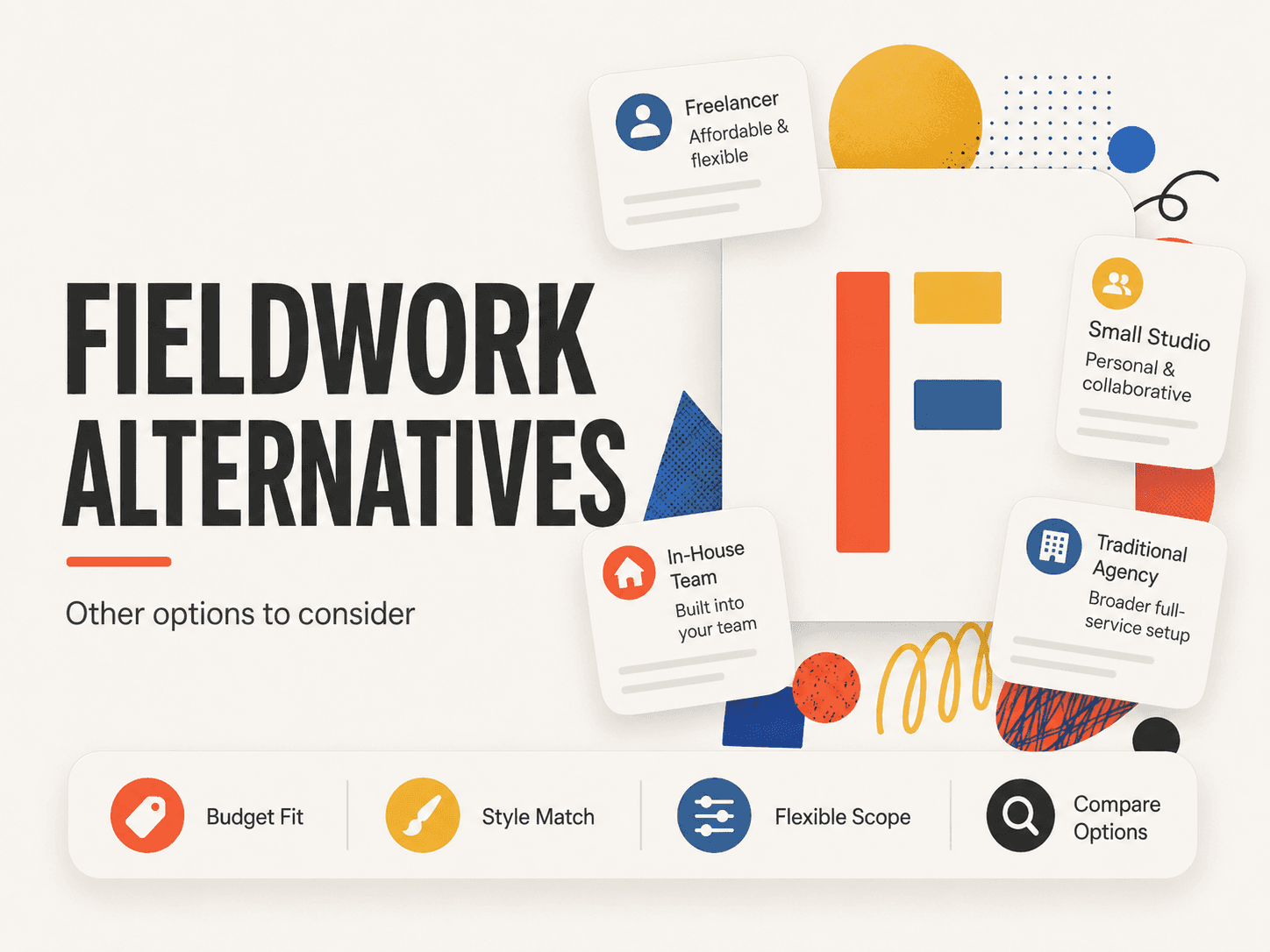
If you are comparing Fieldwork alternatives, do not only compare studio names. Compare the type of help you actually need.
Alternative type | Best for | Why choose it instead |
Another Framer specialist | Fast websites, landing pages, and no-code builds | Useful if the main need is speed, platform expertise, and responsive execution. |
Product design studio | Dashboards, UX flows, app screens, and product systems | Better if the core problem is product experience rather than a marketing site. |
Branding studio | Positioning, identity, logo systems, and brand strategy | Better if the brand foundation is weak before the website starts. |
CRO-focused landing page agency | Paid traffic pages and conversion testing | Better if the main goal is measurable funnel performance. |
Freelance designer | MVPs, simple pages, and lower-budget tasks | Lower cost and leaner communication. |
Kedara | Landing pages, websites, Figma UI, Webflow, Framer, and white-label support | Useful if you want a leaner design and no-code partner. |
Some named alternatives to compare include Fineart, Beew Studio, Webstacks, Clay, and SVZ. These are not automatically better choices. They are useful comparisons because they solve similar problems with different budgets, styles, and collaboration models.
Disclosure Before Mentioning Kedara
Disclosure: I run a smaller design and no-code studio, so I may include Kedara as a more flexible alternative where relevant. This does not mean Fieldwork is bad. The goal of this review is to help you compare options honestly.
If you like Fieldwork’s design-focused approach but want to compare a more flexible design and development partner, you can also check out Kedara.
Kedara works with startups, founders, and agencies on:
Landing page design
Website design
Figma UI design
Webflow development
Framer development
White-label design support
Kedara may be a better fit if you want a leaner collaboration style, custom page-by-page scope, or ongoing design/development support instead of a fixed premium package. The choice is not simply Fieldwork vs Kedara. The better question is whether you need a specialist studio at Fieldwork’s level or a more flexible design/dev partner for your current stage.
Final Verdict: Is Fieldwork Worth It?
My final view is simple: Fieldwork is worth considering if you like their style, their public proof matches your project type, and the pricing makes sense for your stage.
I would not call Fieldwork the cheapest option, and I would not say it is perfect for every project. But if you need a Manchester design and technology studio for brands, digital products, and services and the portfolio matches your taste, it can be a strong option to compare.
Before hiring Fieldwork, I would check recent work, exact deliverables, timeline, revision process, ownership, platform access, support after launch, and whether the studio has done work close to your category.
If the budget feels too high or the scope feels too heavy, compare smaller studios, Framer/Webflow specialists, freelancers, or Kedara before making a final decision.
FAQ
Is Fieldwork legit?
Yes, Fieldwork appears legitimate based on the public sources I could verify. Buyers should still check recent work and confirm scope before hiring.
How much does Fieldwork cost?
I could not find a public fixed pricing page for Fieldwork. That means buyers should treat pricing as quote-based and ask for a clear scope, team setup, deliverables, timeline, and ownership terms before starting.
What services does Fieldwork offer?
Fieldwork appears to offer services such as brand design, digital product design, service design, technology platforms, user-centred digital products, campaign and cause-led digital work. Exact scope should be confirmed directly.
Who should hire Fieldwork?
Fieldwork is best for organisations that want a thoughtful studio for brand, digital product, service design, and people-centred technology work.
Who should avoid Fieldwork?
Fieldwork may not be ideal for buyers who want public fixed pricing, a fast productized landing page, or a Framer-only specialist.
What are the best Fieldwork alternatives?
Good alternatives include specialist Framer studios, product design studios, branding agencies, freelancers, and flexible studios like Kedara.
Sources / References
Source note: Pricing, ratings, package details, review counts, and public claims can change over time. Always verify directly with the studio before making a hiring decision.

