Design Studio Review
Build in Amsterdam Review 2026: Pricing, Services, Pros, Cons & Is It Worth Hiring?
Read this Build in Amsterdam review covering pricing, services, client reviews, pros, cons, alternatives, and whether Build in Amsterdam is worth hiring for design.
Limited Monthly Offer
Unlimited Requests
Design + Development
Animations Included
Fixed Monthly Price
Introduction
If you are reading this Build in Amsterdam review, you are probably comparing the studio with other serious design partners.
You are probably asking one simple question: Should I hire Build in Amsterdam or not?
That is what I want to help you decide in this article.
My honest view is this: Build in Amsterdam is worth considering if you need high-craft web design, motion, interaction, visual storytelling, and memorable digital experiences and you have the budget for a serious design partner. But I would not say it is the best fit for everyone. Build in Amsterdam's official website positions the studio around ecommerce, web design, digital experiences, which makes the studio relevant for buyers who care about more than basic execution.
At the same time, the main risk is fit. A studio can have a strong portfolio and still be too expensive, too broad, too experimental, or simply not right for your current stage.
So let us break down Build in Amsterdam's pricing, services, reviews, pros, cons, and alternatives clearly.
Quick Verdict: Is Build in Amsterdam Worth Hiring?
Quick verdict: Yes, Build in Amsterdam is worth considering if you are one of the brands, startups, launches, cultural projects, and companies that want a website people remember and you want a design partner with a clear point of view. It may not be ideal for teams that only need a simple conversion page, basic business site, or purely analytics-led CRO program.
Question | Quick answer |
Is Build in Amsterdam legit? | Yes, based on its public website, visible positioning, portfolio/reputation signals, and public sources checked for this review. |
Best for | Brands, startups, launches, cultural projects, and companies that want a website people remember. |
Not best for | Teams that only need a simple conversion page, basic business site, or purely analytics-led cro program. |
Pricing signal | Public fixed pricing was not clearly available in the sources I checked, so buyers should expect to request a quote or proposal. |
Main risk | The biggest risk is not legitimacy. It is whether the studio’s style, budget, timeline, and process match the project. |
My simple take: Build in Amsterdam can be a strong option for the right buyer, but I would not hire them casually. Before booking, I would check recent work, pricing fit, process, team structure, timeline, and whether the studio has solved problems similar to yours.
How I Reviewed Build in Amsterdam
I reviewed Build in Amsterdam based on public research and professional design analysis. I looked at the studio's official website, public positioning, service clarity, portfolio/reputation signals, pricing information where available, buyer fit, and possible risks for different types of clients.
Public third-party reputation data was limited in the sources available to me, so I treated the studio website, portfolio signals, and direct public positioning as the main research inputs.
I have not personally hired Build in Amsterdam. So this review is based on public information, not private client experience.
Criteria | Score | My view |
Service clarity | 8/10 | The public positioning is clear enough to understand the main offer, but buyers should still confirm exact scope. |
Design quality | 8.0/10 | The studio appears strong for ecommerce, web design, digital experiences, based on public positioning and portfolio signals. |
Pricing clarity | 3.5/10 | Pricing is not fully packaged in public, so a custom quote or proposal is still needed. |
Public reputation | 6.5/10 | The available public signals are useful, but I would still check recent work and ask for relevant examples. |
Budget accessibility | 5.0/10 | This looks more suitable for serious projects than very low-budget experiments. |
Buyer fit | 8.0/10 | Strong if the studio's style, process, and budget match the buyer's stage. |
The goal here is not to fake precision. The goal is to give a useful buyer-focused view. When public data is limited, I will say it clearly.
What Is Build in Amsterdam?
If I had to explain Build in Amsterdam simply, I would say it is a design studio or agency focused on ecommerce, web design, digital experiences.
The suggested review angle for this article is: Build in Amsterdam Review: Premium Ecommerce Website Studio. That angle matters because most buyers are not only asking whether the work looks good. They are asking whether the studio is the right kind of partner for their project.
In simple terms, Build in Amsterdam is most relevant when a company needs stronger design judgment than a basic freelancer or template. That could mean a more polished website, a sharper brand system, a better product interface, or a digital experience that helps the business feel more credible.
I would not treat Build in Amsterdam as a generic vendor. Based on the public positioning, this studio looks more useful when design quality affects trust, perception, conversion, launch confidence, or product adoption.
Is Build in Amsterdam Legit?
Yes, from what I could verify publicly, Build in Amsterdam does look legit.
The basic proof points are there: a live website, clear public positioning, visible service direction, and enough public context to understand what kind of work the studio wants to be hired for.
That does not automatically mean Build in Amsterdam is the right fit for your project. It only means the studio is not a random unknown provider. The real question is whether the studio's style, process, budget, and project type match what you need.
Before hiring, I would still ask for:
Recent project examples similar to your company or industry.
A clear written proposal with scope, timeline, deliverables, and exclusions.
Who will actually work on the project day to day.
How feedback, revisions, and approvals are handled.
Whether development, handoff, or post-launch support is included.
What happens if the first creative direction does not feel right.
Build in Amsterdam Services Explained
Build in Amsterdam's main fit in this batch is ecommerce, web design, digital experiences. But service labels can be vague, so here is how I would translate the likely service areas into buyer language.
Service | What it means for the client |
Interactive website design | Custom web experiences with motion, transitions, scroll moments, and strong art direction. |
Digital experience design | Experiences that use visuals, motion, storytelling, and interaction to create a stronger brand memory. |
Creative direction | Defining the look, mood, typography, visual world, and interaction style. |
Frontend development | Building custom experiences that preserve design detail, animation, and responsive behavior. |
Brand or campaign support | Helping the digital experience feel connected to the wider brand or launch. |
Technical QA | Testing performance, responsiveness, interaction behavior, and browser consistency. |
The important thing is not just the service name. A buyer should understand what is included, what is not included, and where the studio's responsibility ends.
For example, if Build in Amsterdam says it offers website design, does that include copy guidance, responsive design, CMS setup, development, QA, analytics, and launch support? Or is it only design direction and Figma files?
That is why I would ask for a clear scope before signing. The same service name can mean very different things depending on the studio.
Build in Amsterdam Pricing
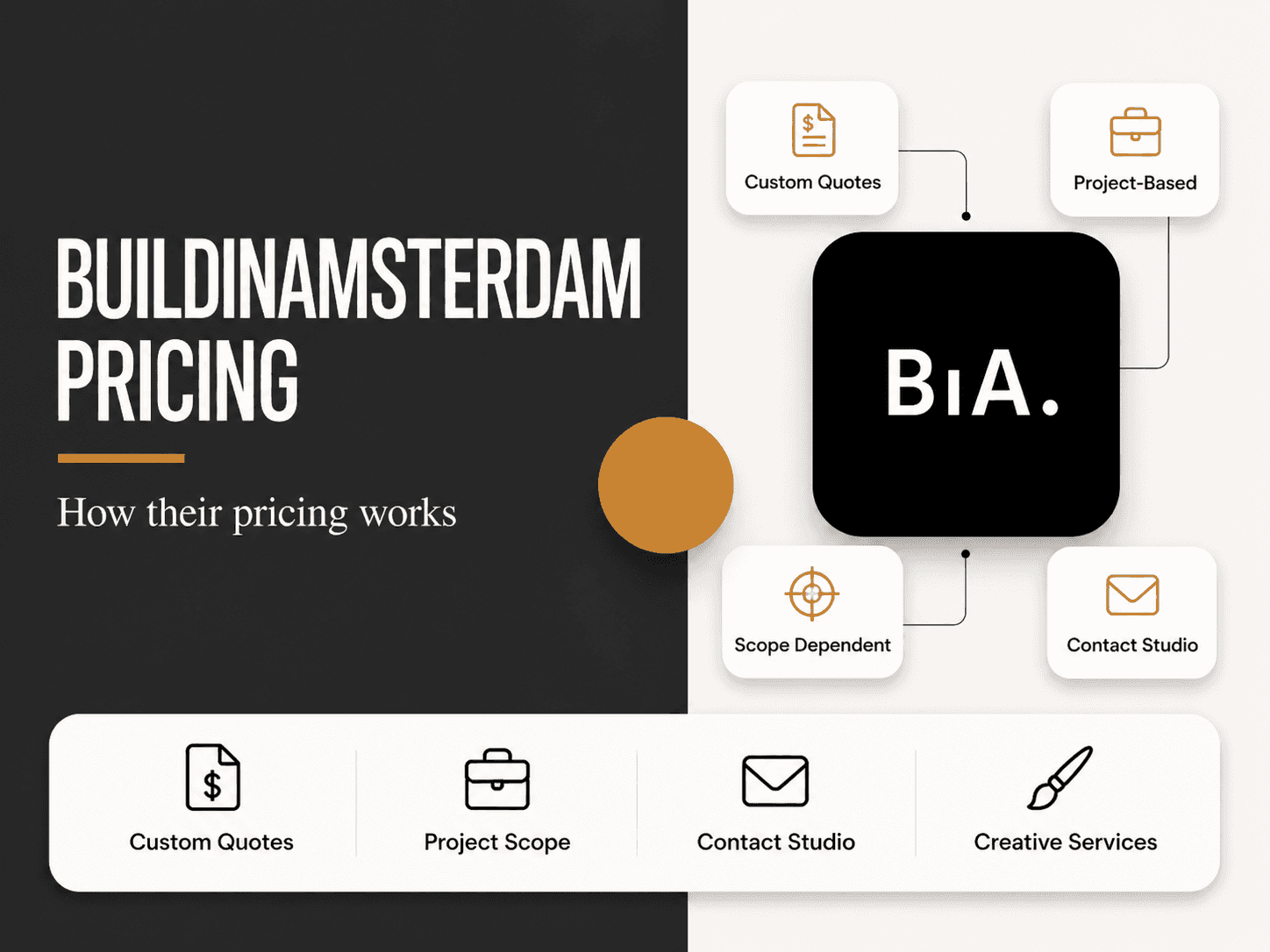
I could not verify a simple fixed public pricing page for Build in Amsterdam while preparing this article. That means you may need to contact the studio directly for a quote.
Last checked: May 5, 2026.
Pricing item | Public signal | What I would confirm |
Website or brand project | Quote required / not clearly fixed in public sources | Confirm page count, deliverables, responsive views, development, revision rounds, and timeline. |
Product or UX work | Usually scope-based | Confirm whether research, wireframes, prototypes, design systems, and developer handoff are included. |
Development or implementation | Depends on the studio's model | Confirm whether Webflow, Framer, custom frontend, CMS, QA, and launch support are included. |
Retainer or ongoing support | Not assumed unless public or proposed | Confirm monthly capacity, response time, active requests, and what counts as extra scope. |
So no, I would not treat Build in Amsterdam as a cheap option unless the studio clearly says otherwise in a proposal.
For most buyers, the safer assumption is that a serious design studio engagement will cost more than a simple freelancer project. That does not make it bad. It just means you should only hire the studio when the design outcome is important enough to justify the investment.
My advice is simple: do not compare only by price. Compare by scope, quality, communication, timeline, ownership, and whether the studio understands your business model.
What Do You Actually Get?
What you get with Build in Amsterdam depends on the project. Still, based on the studio type and public positioning, these are the deliverables I would expect to discuss before hiring.
Feature / deliverable | Included? | Notes |
Creative concept | Confirm in proposal | The central idea behind the experience, not just a page layout. |
Wireframes or page structure | Confirm in proposal | A plan for the content and interaction flow before the visual layer is finalized. |
High-fidelity design | Confirm in proposal | Detailed page designs with typography, color, imagery, motion notes, and interaction intent. |
Motion and interaction direction | Confirm in proposal | Animations, transitions, scroll behavior, or micro-interactions that make the site feel alive. |
Frontend implementation | Confirm in proposal | A custom build or platform-based implementation depending on scope. |
Performance checks | Confirm in proposal | Very important for animation-heavy websites, especially on mobile. |
The most useful thing here is not just the final design. It is the clarity of the workflow.
Before hiring, I would ask these questions:
Will the final design be delivered in Figma or another editable format?
Are desktop, tablet, and mobile versions included?
Is development included, or is this design-only?
How many revision rounds are included?
Who owns the final files and assets?
Will the studio help with launch or only hand off files?
What does the timeline look like from kickoff to final delivery?
What kind of support is available after launch?
This matters because a good-looking portfolio does not automatically tell you how the project will feel as a client. A strong buying decision should be based on both the work and the process.
Build in Amsterdam Client Reviews and Reputation
This is where I would be careful and balanced.
Build in Amsterdam has enough public positioning to be reviewed, but public review depth can vary a lot by studio. Some studios have detailed Clutch or DesignRush reviews. Others are known more through portfolio quality, awards, client logos, social proof, or design community reputation.
For Build in Amsterdam, I would look at three reputation layers:
Portfolio quality: does the recent work match the kind of project you need?
Public proof: are there awards, client examples, directory profiles, case studies, or public mentions?
Buyer relevance: does the studio work with companies similar to yours, or only with a very different type of client?
If public reviews are limited, I would not treat that as an automatic red flag. Some strong studios do not collect many public reviews. But it does mean you should ask better questions before hiring.
Useful questions to ask:
Can you show recent work similar to my industry or project type?
What were the business goals behind those projects?
How did you decide the strategy and design direction?
Can I speak to a past client or see a detailed testimonial?
What kind of client is not a good fit for your process?
How do you measure whether the design worked after launch?
Why Build in Amsterdam Is Interesting for Interactive Web Experiences
Build in Amsterdam is interesting because interactive web work can create a strong first impression, but it can also become risky if the experience is more impressive than useful.
A high-craft website should still help users understand the offer, trust the brand, and take the next step. Motion, 3D, scroll effects, and experimental layouts should support the message, not hide it.
So if I were hiring Build in Amsterdam, I would ask how they balance visual ambition with clarity, performance, mobile usability, accessibility, and conversion.
My Honest Design Opinion
My honest design opinion is that Build in Amsterdam is most interesting when a buyer needs ecommerce, web design, digital experiences and wants a studio with a stronger point of view than a basic production vendor.
I would not judge the studio only by how the homepage looks. I would look at the full experience: layout, typography, spacing, responsiveness, content hierarchy, motion, usability, and whether the design makes the business easier to understand.
The best studio work usually has two layers. The first layer is visual taste. The second layer is business usefulness.
If Build in Amsterdam's work looks beautiful but does not help the user understand the product, trust the company, or take action, then the design is incomplete. But if the visual direction supports clarity and confidence, the design can become a real business asset.
Before hiring Build in Amsterdam, I would check recent portfolio work closely and ask myself:
Does this studio's style match the brand I am trying to build?
Does the work feel clear, or only visually impressive?
Would my customers understand the product faster after this redesign?
Does the studio show enough range, or does every project feel the same?
Can the studio explain design decisions in business language, not just visual language?
Will this design system still work six months after launch?
That is the kind of thinking that separates a nice-looking design from a design decision that actually helps the company.
Pros of Hiring Build in Amsterdam
Strong category fit
Build in Amsterdam is clearly relevant for buyers looking for ecommerce, web design, digital experiences. That makes the studio easier to evaluate than a vague generalist agency.
Better design quality than basic providers
The studio appears positioned for companies that want more polish than a template, cheap freelancer, or quick production vendor.
Useful for serious launches
A studio like this can be valuable before a funding announcement, product launch, rebrand, campaign, or major website update.
Clearer point of view
The best design partners do not just execute tasks. They help shape direction, simplify decisions, and improve how the company is perceived.
Good fit when design affects trust
If prospects judge your product or brand through the website, identity, or interface, a stronger studio can help the company feel more credible.
Potential strategic value
Depending on scope, the studio may help with structure, messaging, UX, visual system, and implementation rather than only final visuals.
Stronger alternative to hiring internally too early
For some teams, hiring a studio can be faster than recruiting and managing a senior full-time designer.
Cons of Hiring Build in Amsterdam
It may be expensive
A serious studio engagement is usually not the cheapest route. If your budget is very small, you may need a freelancer, smaller studio, or narrower scope first.
Pricing may not be public
If the studio does not show fixed pricing, buyers need to request a proposal and compare scope carefully.
It may be too much for simple projects
A premium studio can be overkill if you only need one basic page, a small UI refresh, or a quick template build.
Style fit matters
Even a strong studio can be wrong for a brand if the visual style does not match the audience, market, or business model.
Public reviews may be limited
Some studios rely more on portfolio and reputation than review platforms, so buyers should ask for direct proof and relevant examples.
Development scope should be confirmed
Do not assume build, QA, CMS, animations, or post-launch support are included unless the proposal says so clearly.
Strategy depth can vary
Some studios are strongest at execution, while others are stronger at research and strategy. Ask how the process works before hiring.
Who Should Hire Build in Amsterdam?
Build in Amsterdam may be a good fit if:
You need ecommerce, web design, digital experiences and want a serious design partner.
You have a real budget for design and do not want the cheapest possible option.
Your company is preparing for a launch, rebrand, fundraising push, or product update.
Your current website, brand, or product interface feels weaker than the quality of your actual product.
You care about trust, perception, usability, and how people feel when they first interact with your company.
You want a more complete process than simply asking a freelancer to make something look better.
You are ready to give clear feedback and make decisions during the project.
You want a studio that can bring taste, structure, and design judgment to the project.
I think Build in Amsterdam is especially interesting when the design work is not just decoration. If better design can improve trust, sales, adoption, clarity, or brand perception, then a stronger studio can be worth considering.
Who Should Avoid Build in Amsterdam?
Build in Amsterdam may not be the best fit if:
Your budget is very low.
You only need a basic one-page website.
You want the cheapest possible designer.
You are still validating the idea and do not know if the market wants it yet.
You need heavy backend engineering more than design.
You expect a full internal team replacement without paying for that level of support.
You are not clear about your project goals yet.
You do not have time to give feedback, review work, and make decisions.
You want lots of strategy workshops but the studio is mainly execution-focused, or the reverse.
This does not mean Build in Amsterdam is bad. It just means every studio has a specific fit. For some founders, it may be perfect. For others, it may be too expensive, too advanced, or simply not aligned with the project.
Best Build in Amsterdam Alternatives
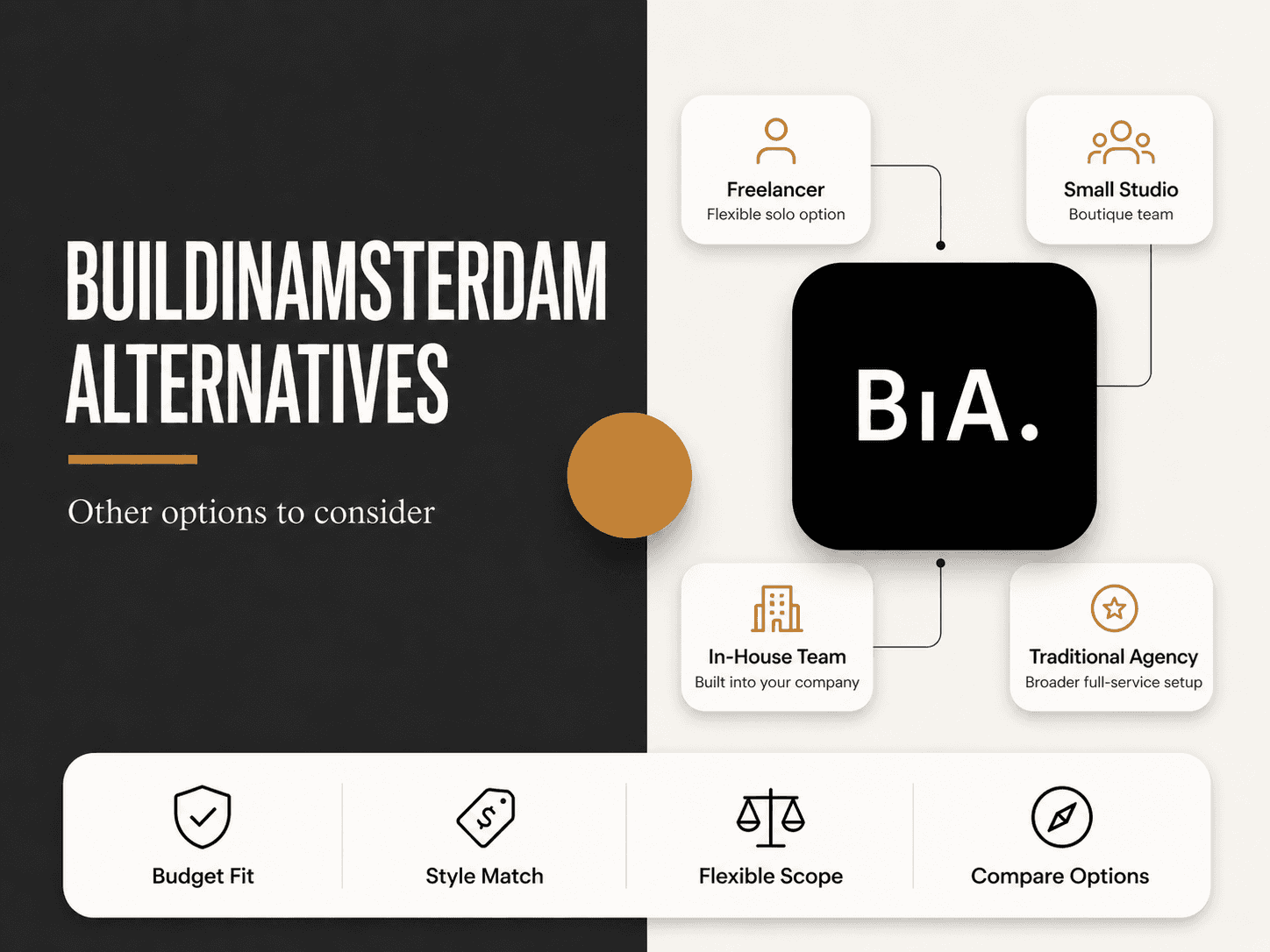
If you are comparing Build in Amsterdam alternatives, I would not only compare names. I would compare the type of support you actually need.
Alternative type | Best for | Why choose it instead |
Smaller design studio | Landing pages, websites, brand refreshes, and focused scopes | Often more flexible and more affordable than a premium agency engagement. |
Freelance designer | Early MVPs, simple websites, and small design tasks | Lower cost, direct communication, and less process. |
Traditional agency | Larger companies that need strategy, workshops, and multi-stakeholder support | Better for complex organizations with approval layers. |
Product design studio | SaaS UX, dashboards, onboarding, and app flows | Better when product usability is the main challenge. |
Webflow/Framer specialist | Teams that already have designs or need a fast live website | Better if the main need is clean build execution. |
In-house designer | Companies with daily design needs | More internal context and long-term ownership. |
Some named alternatives to compare include Refokus, Obys Agency, Exo Ape, Locomotive, Active Theory, and Resn, plus smaller AI/product studios or Webflow/Framer specialists depending on the project.
The best alternative to Build in Amsterdam depends on whether you need premium brand strategy, product UX, website execution, conversion-focused landing pages, or a flexible design and development partner.
Disclosure Before Mentioning Kedara
Disclosure: I run a smaller design and no-code studio, so I may include Kedara as a more flexible alternative where relevant. This does not mean Build in Amsterdam is bad. The goal of this review is to help you compare options honestly.
If you like Build in Amsterdam's design-focused approach but want to compare a more flexible design and development partner, you can also check out Kedara.
Kedara works with startups, founders, and agencies on:
Landing page design
Website design
Figma UI design
Webflow development
Framer development
White-label design support
Kedara may be a better fit if you want a leaner collaboration style, custom page-by-page scope, or ongoing design/development support instead of a larger premium studio engagement.
So the choice is not simply "Build in Amsterdam vs Kedara." The better question is: do you need Build in Amsterdam's specific studio style and process, or do you need a more flexible design and no-code partner?
Final Verdict: Is Build in Amsterdam Worth It?
My final view is simple.
Build in Amsterdam is worth considering if you have the budget, like the studio's style, and need ecommerce, web design, digital experiences at a serious level.
It is not the right fit for everyone. I would not choose a studio only because the portfolio looks strong. I would choose it because the scope, process, team, timeline, and expected outcome all make sense.
Before hiring Build in Amsterdam, I would check:
Recent portfolio examples.
Whether your project type fits their strengths.
What is included in the proposal.
Whether development, QA, and launch support are included.
How feedback and revisions work.
Who will be on the project team.
What timeline is realistic.
Whether the budget makes sense for your current stage.
If the portfolio matches your taste and the budget fits your stage, Build in Amsterdam can be a strong option.
If the budget feels too high or the scope is too large, compare smaller studios, freelancers, Webflow/Framer specialists, product studios, or Kedara before making a final decision.
FAQ
Is Build in Amsterdam legit?
Yes, Build in Amsterdam appears legit based on its public website, positioning, and available public reputation signals. Buyers should still check recent work and confirm fit before hiring.
How much does Build in Amsterdam cost?
I could not verify simple fixed public pricing for Build in Amsterdam. You should contact the studio directly for a current quote based on scope, timeline, and deliverables.
What services does Build in Amsterdam offer?
Build in Amsterdam is mainly relevant for ecommerce, web design, digital experiences. The exact scope should be confirmed in a written proposal.
Is Build in Amsterdam good for startups?
Build in Amsterdam can be a good fit for startups if design quality is important and the budget is realistic. It may not be ideal for very early low-budget experiments.
Does Build in Amsterdam include development?
That depends on the project and the studio's proposal. Always confirm whether development, QA, CMS setup, and launch support are included.
Who should hire Build in Amsterdam?
Teams that need serious ecommerce, web design, digital experiences and want a stronger design partner than a basic freelancer should consider Build in Amsterdam.
Who should avoid Build in Amsterdam?
Low-budget founders, simple one-page projects, and teams with unclear goals may want to start with a smaller or more focused option.
What are the best Build in Amsterdam alternatives?
The best alternatives depend on the goal. Compare smaller studios, freelancers, product design studios, Webflow/Framer specialists, and named studios in the alternatives section.
Sources / References
I used these public sources to verify the main claims in this review:
Source note: Public sources are useful for comparison, but the final hiring decision should still be based on a current proposal and direct conversation with the studio.