Design Studio Review
Webstacks Review 2026: Pricing, Services, Pros, Cons & Is It Worth Hiring?
Read this Webstacks review covering pricing, services, client signals, pros, cons, alternatives, and whether Webstacks is worth hiring for design.
Limited Monthly Offer
Unlimited Requests
Design + Development
Animations Included
Fixed Monthly Price
Introduction
This Webstacks review is for founders and teams trying to decide whether the studio is actually worth hiring.
You are probably asking one simple question: should I hire Webstacks or not?
That is what I want to help you decide in this article.
My honest view is this: Webstacks is worth considering if you need digital design, website structure, visual polish, and practical execution. It may not be the best fit if you need projects where backend engineering or long enterprise research is the main problem.
From the public information I checked, Webstacks's official website positions the studio around b2b saas websites, composable websites, web ops, which makes it most relevant for founders and teams that need better websites, digital design, and visual communication.
At the same time, a good portfolio does not automatically mean the studio is right for every buyer. Pricing, process, scope, review signals, and fit matter just as much as taste.
So let us break down Webstacks's pricing, services, reviews, pros, cons, and alternatives clearly.
Quick Verdict: Is Webstacks Worth Hiring?
Quick verdict: Yes, Webstacks is worth considering if you are a founder or team that needs better websites, digital design, and visual communication. The studio looks strongest when the project needs digital design, website structure, visual polish, and practical execution. But it may not be ideal for projects where backend engineering or long enterprise research is the main problem.
Question | Quick answer |
Is Webstacks legit? | Yes, based on the official website, public positioning, portfolio or service information, and the wider public proof signals available. |
Best for | Founders and teams that need better websites, digital design, and visual communication. |
Not best for | Projects where backend engineering or long enterprise research is the main problem. |
Pricing signal | Pricing is usually custom, so buyers should confirm scope, timeline, and deliverables before hiring. |
Main risk | Buyers should check recent work carefully because style, process, and depth can vary from studio to studio. |
My simple take: Webstacks can be a smart option for the right buyer, but I would not hire them casually. Before booking a call, I would check whether the portfolio style fits your brand, whether the process matches how your team works, and whether the budget makes sense for your stage.
How I Reviewed Webstacks
I reviewed Webstacks based on public research and professional design analysis. I looked at the official website, service positioning, portfolio signals, public reputation signals, pricing clarity, buyer fit, and how the studio compares with similar options in the same category.
I have not personally hired Webstacks. So this review is based on public information, not private client experience.
Criteria | Score | My view |
Service clarity | 8/10 | The offer is understandable from the public positioning, but buyers should still confirm scope directly. |
Visual/design quality | 8/10 | The studio appears to have a strong design lane based on its category and public positioning. |
Pricing clarity | 6/10 | Pricing is not fully standardized in the public information, so quotes and plan details should be confirmed. |
Public reputation | 6.5/10 | The public proof is useful, but review depth should be checked before making a final decision. |
Budget accessibility | 7/10 | Likely more accessible than top global agencies, but still depends heavily on scope. |
Buyer fit | 7/10 | Strongest for founders and teams that need better websites, digital design, and visual communication. |
The goal here is not to fake precision. The goal is to give a useful buyer-focused view. When public data is limited, I will say it clearly.
What Is Webstacks?
If I had to explain Webstacks simply, I would say it is a design studio or agency focused on b2b saas websites, composable websites, web ops.
The studio appears to serve founders and teams that need better websites, digital design, and visual communication. That means it is not only about making something look nice. The real value is whether the work helps a company communicate more clearly, launch faster, build trust, or make the product easier to understand.
The review angle from the research sheet is: Webstacks Review: B2B SaaS Website Agency Breakdown. That is useful because it gives the article a clear question instead of turning it into a generic agency overview.
The country or market context listed for this studio is United States. That does not matter as much as the work quality, but it can matter for collaboration style, time zones, pricing expectations, and buyer confidence.
Overall, Webstacks looks most relevant for buyers who want web-led, visual, and best when the company needs a stronger online presence.
Is Webstacks Legit?
From what I could verify from public information, Webstacks appears to be a real studio or service provider, not just a random listing.
The main proof points I would look at are:
A live official website with a clear offer or service positioning.
Portfolio, case studies, examples, or public work samples.
Founder, team, or company presence that makes the studio easier to verify.
Public review platforms, directory listings, awards, partner pages, or social proof where available.
Clear service language that helps a buyer understand what they are actually buying.
That does not automatically mean Webstacks is perfect for every project. It only means the studio has enough public presence to be worth evaluating seriously.
The better question is not only whether the studio is real. The better question is whether the studio is right for your exact project, budget, and expectations.
Webstacks Services Explained
Based on the public service positioning and the details provided in the research sheet, Webstacks is mainly connected with b2b saas websites, composable websites, web ops.
Service | What it means for the client |
Creative direction | Sets the mood, interaction style, and visual system for the digital experience. |
Website design | Creates a more distinctive website or campaign experience. |
Motion and interaction | Adds animation, movement, and memorable transitions where useful. |
Development or production | Turns the experience into a working digital asset when included. |
Brand storytelling | Helps the product or campaign feel more emotional, memorable, and differentiated. |
The important thing is to confirm what is included in your exact scope. A phrase like “B2B SaaS websites, composable websites, web ops” can mean different things depending on the studio, project size, and timeline.
Webstacks Pricing
I could not rely on one universal public price for Webstacks from the spreadsheet alone, so I would treat the pricing as something to verify directly before making a decision.
Pricing area | What to confirm |
Starting budget | Ask whether the studio has a minimum project size or minimum monthly plan. |
Project scope | Confirm whether strategy, design, development, copy, motion, and QA are included. |
Timeline | Ask how long a typical project takes and what can delay delivery. |
Revision process | Clarify how many rounds are included and how feedback is handled. |
Ongoing support | Ask whether post-launch edits, CMS support, or retainers are available. |
So no, I would not treat Webstacks as a random low-cost option unless the studio clearly says that is their model. The safer assumption is that pricing depends on scope, quality expectations, and how much strategy or execution support you need.
My advice is simple: do not ask only “how much does it cost?” Ask what is included, what is not included, what counts as a revision, what happens after launch, and how the team handles unclear scope.
What Do You Actually Get?
What you get with Webstacks depends on the project, but a buyer should expect the deliverables to match the studio’s service category.
Deliverable | Why it matters |
Discovery or briefing | A clear starting point for goals, audience, scope, and success criteria. |
Design direction | Mood, references, layout direction, visual system, and early concepts. |
Core design files | Usually Figma or design files for websites, products, or brand assets. |
Responsive thinking | Desktop, tablet, and mobile considerations for web work. |
Development or handoff | Either a live build, a handoff package, or collaboration with developers depending on scope. |
Launch or support | QA, final adjustments, CMS help, or ongoing support if included. |
The most important thing to confirm is not just the final file format. It is the level of thinking behind the work.
For a serious project, I would ask Webstacks for recent examples that match your type of work. A studio can be great at one kind of project and not ideal for another.
Webstacks Client Reviews and Reputation
Public review data for Webstacks may vary by platform. Some studios have strong Clutch or Google review profiles. Others rely more on portfolio, social proof, awards, partnerships, or client logos.
The reputation signals I would check before hiring are:
Recent client testimonials, not only old portfolio claims.
Review count and review quality on platforms like Clutch, DesignRush, Google, or relevant marketplaces.
Whether the reviewed projects match your own project type.
Whether clients mention communication, deadlines, revisions, and business results.
Whether the studio shows enough recent work to prove it is still active.
For Webstacks, I would treat the official portfolio and current website as the strongest first signal, then use public reviews or directory profiles as supporting proof if they are available.
If public review data is limited, that is not automatically a red flag. But it does mean you should ask better questions on the sales call.
Why Webstacks Is Interesting
The reason Webstacks is worth reviewing is that it sits in a useful buyer category: web-led, visual, and best when the company needs a stronger online presence.
For many founders, the hard part is not finding any designer. The hard part is finding a design partner whose level of taste, process, and pricing fits the business stage.
Webstacks may be interesting because it gives buyers a specific lane to evaluate. Instead of asking whether the studio is “good” in a general way, the better question is whether its strengths match your project.
That is also why I would not compare every studio only by price. A cheaper option can be better for a simple landing page. A more premium option can be better when the design has to carry trust, positioning, or product clarity.
My Honest Design Opinion
My honest view is that Webstacks should be evaluated on fit, not hype.
If the studio’s portfolio and positioning match your brand direction, it can be a strong option. If the style feels far away from your product, audience, or category, I would be careful even if the work looks polished.
The strongest design partners are not only good at visuals. They are good at making decisions clearer. They help you decide what to say, what to remove, what to simplify, and what needs more emphasis.
For Webstacks, I would pay close attention to typography, spacing, conversion flow, content clarity, mobile behavior, and whether the design helps the buyer understand the offer faster.
A beautiful website that confuses users is still a weak website. A simple website that explains the product clearly can sometimes perform better. The right answer depends on the goal.
Pros of Hiring Webstacks
Clear category fit: Webstacks is tied to b2b saas websites, composable websites, web ops, which makes it easier to know when to consider them.
Good fit for founders and teams that need better websites, digital design, and visual communication.
Potentially stronger than a generalist freelancer when the project needs digital design, website structure, visual polish, and practical execution.
Public website and positioning make the studio easier to evaluate before booking a call.
Can be useful if you want a more polished result than a quick template or basic execution project.
The review angle gives buyers a clear way to compare the studio against similar alternatives.
Cons of Hiring Webstacks
May not be ideal for projects where backend engineering or long enterprise research is the main problem.
Pricing may not be fully visible upfront, so buyers need to ask direct questions before committing.
Public review data may be limited or spread across platforms, so portfolio quality should be checked carefully.
The studio’s style may not fit every brand, even if the work looks good.
If your project goals are unclear, you may waste budget on design before solving positioning or strategy.
You should confirm timelines, ownership of files, revision rules, and post-launch support before signing.
These are not necessarily deal-breakers. They are just the things I would check before hiring.
Who Should Hire Webstacks?
Webstacks may be a good fit if:
You are part of founders and teams that need better websites, digital design, and visual communication.
You need digital design, website structure, visual polish, and practical execution.
You care about how design affects trust, clarity, perception, and conversion.
You have enough budget to hire a specialist instead of the cheapest possible option.
You can give clear feedback and make decisions during the process.
You want a design partner that understands the category rather than a generic vendor.
Who Should Avoid Webstacks?
Webstacks may not be the best fit if:
Your budget is very low.
You only need a basic one-page website or a small design task.
You want the cheapest possible designer.
You need heavy backend engineering more than design.
You need months of research before any visual work starts.
You are not clear about your offer, audience, or project goals yet.
You want a very traditional corporate agency process and lots of formal workshops.
This does not mean Webstacks is bad. It just means every studio has a specific fit.
Best Webstacks Alternatives
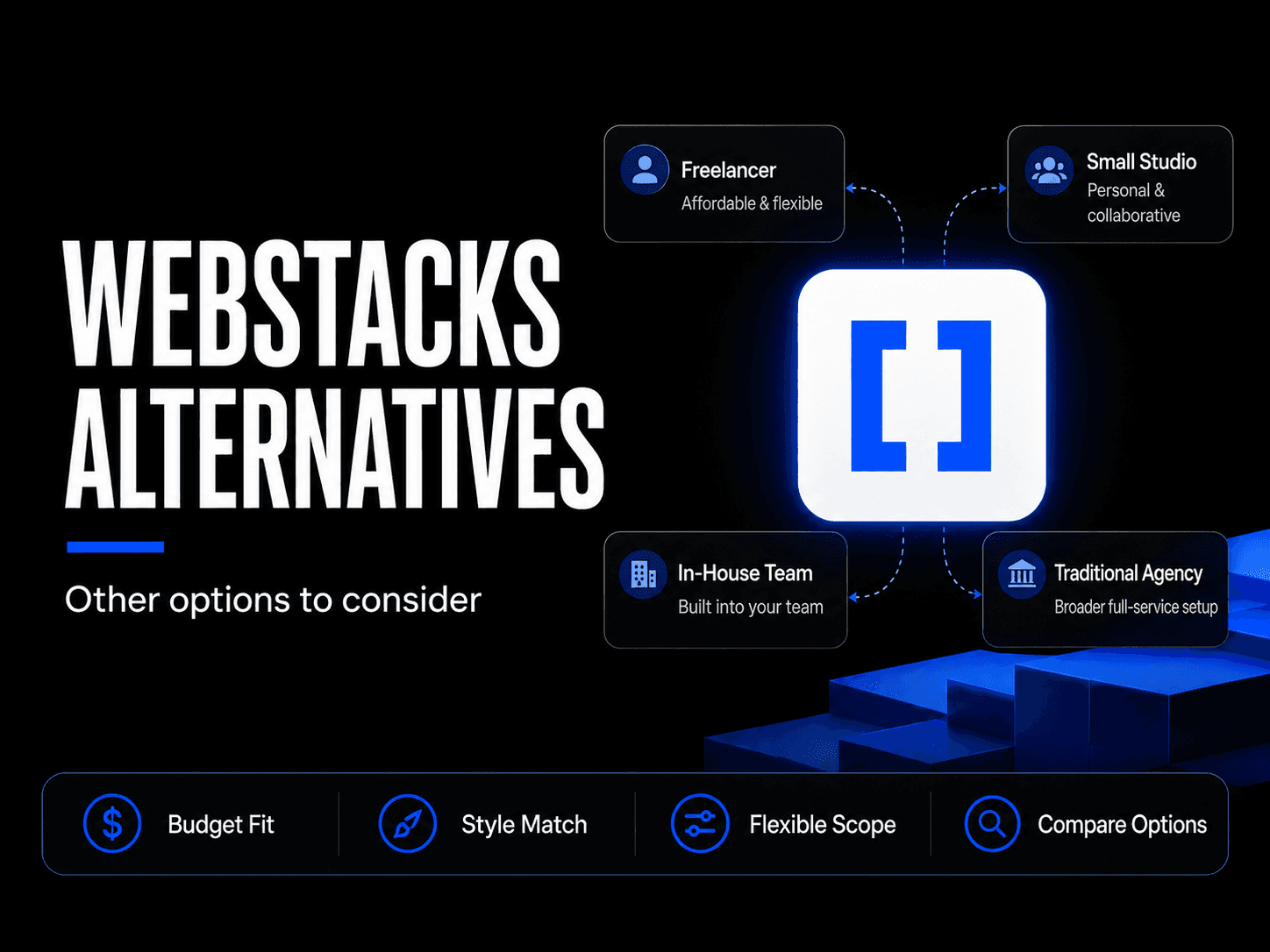
If you are comparing Webstacks alternatives, I would not only compare names. I would compare the type of support you actually need.
Alternative type | Best for |
Premium design studio | Useful if you want a similar quality level but a different style or process. |
Specialist studio | Better if your main need is exactly b2b saas websites, composable websites, web ops. |
Freelance designer | Good for smaller scopes, MVPs, or early-stage tests. |
Webflow/Framer specialist | Better if you already have a design direction and mainly need a clean live build. |
In-house designer | Better if you need daily design support and long-term product context. |
Kedara | Useful when the buyer wants a leaner design and no-code partner. |
Some named alternatives to compare include Clay, Ramotion, Finsweet, Baunfire, and SVZ.
Disclosure Before Mentioning Kedara
Disclosure: I run a smaller design and no-code studio, so I may include Kedara as a more flexible alternative where relevant. This does not mean Webstacks is bad. The goal of this review is to help you compare options honestly.
If you like Webstacks's design-focused approach but want to compare a more flexible design and development partner, you can also check out Kedara.
Kedara works with startups, founders, and agencies on:
Landing page design
Website design
Figma UI design
Webflow development
Framer development
White-label design support
Kedara may be a better fit if you want a leaner collaboration style, custom page-by-page scope, or ongoing design/development support instead of a bigger or more fixed studio process.
So the choice is not simply “Webstacks vs Kedara.” The better question is: do you need Webstacks's exact studio model, or do you need a more flexible design and no-code partner?
Final Verdict: Is Webstacks Worth It?
My final view is simple: Webstacks is worth considering if your project needs digital design, website structure, visual polish, and practical execution and the studio’s style matches your brand.
I would not call it the right fit for everyone. If you are projects where backend engineering or long enterprise research is the main problem, I would compare other options before booking a call.
Before hiring Webstacks, I would check:
Recent portfolio examples similar to your project.
Current pricing or minimum project size.
What exactly is included in the scope.
Whether design, development, copy, motion, and strategy are included or separate.
How feedback, revisions, and timelines work.
Whether the studio has recent reviews or client proof in your category.
If the portfolio matches your taste and the scope fits your budget, Webstacks can be a strong option. If the pricing feels too high or the process feels too fixed, compare smaller studios, freelancers, no-code specialists, or Kedara before making a final decision.
FAQ
Is Webstacks legit?
Yes, Webstacks appears to be a legitimate studio or service provider based on the public website and available positioning. Buyers should still verify recent work, pricing, and reviews before hiring.
How much does Webstacks cost?
Webstacks pricing should be checked directly with the studio. Public pricing may be limited, quote-based, or dependent on project scope.
What services does Webstacks offer?
Webstacks is mainly connected with b2b saas websites, composable websites, web ops. Exact deliverables should be confirmed before hiring.
Who is Webstacks best for?
Webstacks is best for founders and teams that need better websites, digital design, and visual communication.
Who should avoid Webstacks?
Webstacks may not be ideal for projects where backend engineering or long enterprise research is the main problem.
What are the best Webstacks alternatives?
The best alternatives depend on your budget and scope. Consider specialist studios, freelancers, Webflow/Framer experts, in-house designers, or Kedara.
Sources / References
I used the following public sources and source types while preparing this review:
Source note: Pricing, ratings, package details, review counts, and public claims can change over time. Always verify directly with the studio before making a hiring decision.