Design Studio Review
Design Force Review 2026: Pricing, Services, Pros, Cons & Is It Worth Hiring?
Design Force review: compare current pricing, services, pros, cons, and alternatives. See its managed production, hours, and rollover terms before choosing a design partner.

Limited Monthly Offer
Unlimited Requests
Design + Development
Animations Included
Fixed Monthly Price
Introduction
Sometimes the design problem isn't strategy. Your team knows what it needs but can't get the assets produced without delaying campaigns or releases. This Design Force review looks at a subscription that explicitly keeps strategy in-house while handling production, process, and delivery.
That division can work well, especially when the gap is bigger than a freelancer task but smaller than another full-time role. The buying question is whether its finite hours, skill mix, and rollover terms match your real workload.
Quick Verdict: Is Design Force Worth Hiring?
I'd shortlist Design Force for teams with established direction and recurring marketing or product-design production. The official model separates marketing and product needs, and the pricing FAQ publishes hour allocations. Don't interpret unlimited projects as unlimited output or assume website design includes engineering.
Question | My short answer |
|---|---|
Legit? | A live offer, named client testimonials, and independent feedback. |
Best fit | Teams with strategy in-house and a recurring execution gap. |
Poor fit | Buyers wanting discovery, research, and engineering fully owned by one provider. |
Monthly starting prices | Marketing Force $1,600; Pro Force $2,100; Full Force $3,200. |
Main strength | Managed production with published allocations and longer rollover. |
Main risk | Limited hours, tier-specific scope, overages, and cancellation notice. |
How I Reviewed Design Force
I reviewed the official homepage, full pricing page and FAQ, and independent Trustpilot profile on October 4, 2026. I focused on the difference between marketing and product plans, included roles, hour usage, rollover, and what a design handoff actually proves.
I haven't personally hired Design Force. This is public-source professional analysis, not a customer testimonial. I haven't audited its delivery statistics, growth claims, or every project. Client statements are attributed experiences rather than guaranteed business results.
What Is Design Force?
Design Force describes itself as a fully managed, on-demand design partner. Its homepage says strategy stays in-house while the provider handles production, process, and delivery. The basic workflow is request, design, review, and handoff.
That positioning is useful because it tells you what not to outsource by accident. If you already have a brand lead, product manager, or marketing director, the team can help turn approved direction into assets. If you don't know what to communicate or how a product should work, production capacity alone may not resolve the uncertainty.
Its plan categories distinguish marketing deliverables from product-design support, with a broader option for combined needs. I'd choose the plan based on the tasks in the next few months rather than the most impressive list of capabilities.
Is Design Force Legit?
The official site has a documented service model and named testimonials discussing work for marketing and product teams. The Trustpilot profile contains separate client accounts of responsiveness, design quality, collaboration, and hour rollover.
At the time of writing, that independent profile showed a small review sample. Small doesn't mean bad, but it limits the confidence you should place in an aggregate rating. I'd put more weight on detailed references and work that resembles your brief.
Before buying, confirm the legal contracting entity, assigned account manager, production lead, and escalation route. Ask what happens if the first designer isn't a fit and whether replacement or rebriefing consumes your purchased capacity.
Design Force Services Explained
The pricing page's final tier lists separate the following areas. Some earlier page sections repeat broader lists under different headings, so confirm the exact tier inclusions in your proposal.
Service area | What it means for a buyer |
|---|---|
Marketing design | Ads, social graphics, email visuals, ebooks, print collateral, and presentations. |
Motion and animation | Animated assets supporting campaigns and communications. |
Illustration and packaging | Custom visuals or production artwork with agreed specifications. |
Product UIUX | Interfaces, wireframes, mobile-app layouts, and desktop-product design. |
Interaction and prototyping | Demonstrating flows and behavior before implementation. |
Web and landing-page design | Layouts and assets; confirm development separately. |
Branding and visual identity | Design applications or identity work within the selected tier. |
The website-design category is not enough evidence to assume Webflow implementation, hosting, backend coding, or CMS management is included. I didn't verify a clear production-development promise in the reviewed material. If coding matters, ask for the exact platform and deliverables.
Copywriting is specifically described in the FAQ as an add-on to an active design plan, billed separately from design hours. That distinction should be in your campaign budget, not discovered after the first brief.
Design Force Pricing
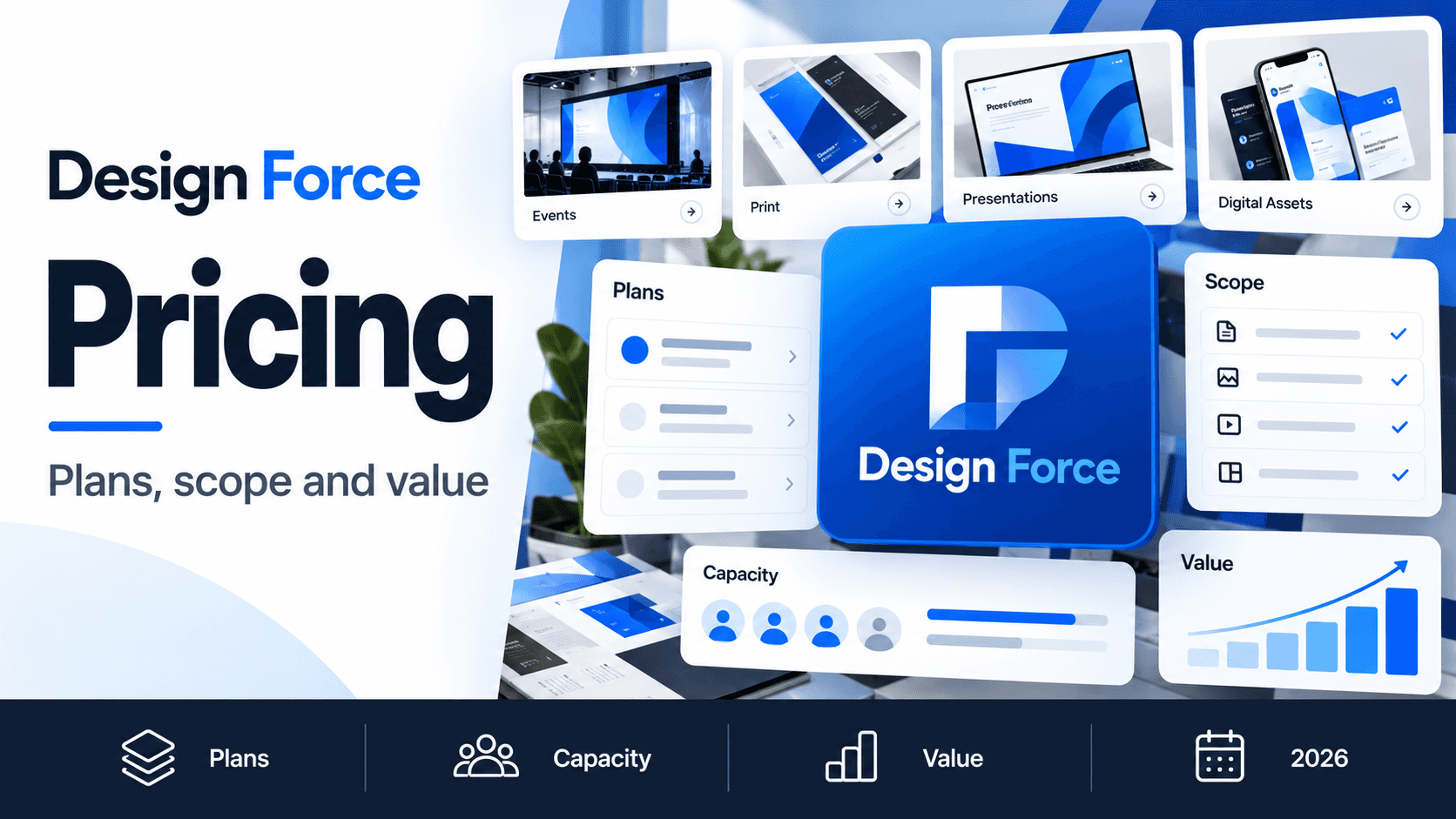
At the time of writing, the official pricing page shows these starting prices and allocations. It uses dollars; confirm invoicing currency and taxes directly.
Plan | Monthly starting price | Annual-plan displayed monthly equivalent | Published monthly hours |
|---|---|---|---|
Marketing Force | $1,600month | $1,500month | 20 hours. |
Pro Force | $2,100month | $2,000month | 25 hours. |
Full Force | $3,200month | $3,000month | 40 hours. |
These are starting prices, not a promise that every custom requirement is covered. The annual plan has a 12-month commitment; the monthly plan is described as month-to-month. Confirm the full annual payment schedule and any cancellation fee before selecting a discount.
The FAQ says unused hours remain available for up to a year while your subscription is active. It also describes billing based on hour needs and says rollover coverage may mean no bill in a given month. That's useful but unusual enough to deserve a worked example in your quote.
Additional time is billed at the package's hourly rate, according to the page. Ask for that overage rate, who can authorize extra hours, and whether work stops when capacity runs out. A starting-price subscription isn't predictable if anyone can approve untracked overages.
Monthly cancellation requires 30 days' notice to the account manager. The page also advertises a 30-day money-back guarantee, but the exact eligibility and ownership consequences should be checked in the agreement rather than assumed from the headline.
What Do You Actually Get?
The published all-plan features include brand onboarding, a dedicated project manager, a creative team and art director, a collaboration tool, unlimited users, revisions, source files, and white-labeling options. The amount of work remains limited by plan hours.
I'd ask how much of that allocation is hands-on design versus coordination, meetings, and revisions. Managed support can absolutely be valuable, but buyers should understand how the work is accounted for and how much production time remains after planning.
For product design, define user flows, screen counts, component variants, responsive behavior, prototype interactions, and developer notes. A set of attractive screens isn't a finished design system. Ask who handles empty states, errors, permissions, loading behavior, and edge cases.
For campaign work, define dimensions, editability, stock licenses, file naming, and brand guidelines. For white-label agency use, confirm confidentiality, portfolio permissions, client access, and whether the provider can communicate directly with your client.
My first test would be a connected, realistic brief: a product feature's interface update, launch graphic, and sales-slide explanation. That shows whether the team can preserve one idea across product and marketing instead of producing unrelated pieces.
Client Reviews and Reputation
The independent Trustpilot accounts reviewed at writing time are positive about communication, speed, understanding brand context, and the fit between a fully staffed internal team and an overloaded single designer. One account specifically describes feedback through working files and ClickUp, with calls available for clarification.
Those are relevant operating details. They suggest clients value the collaboration model, not just the final images. But the profile had only seven reviews in the retrieved material, so I wouldn't claim a broad market consensus or use a precise score as strong proof.
The official testimonials are broader and discuss responsiveness and consistency. They're selected by the provider. Company-published figures about faster delivery or growth should be treated as attributed outcomes, not expected returns on your subscription.
I'd request a recent reference from a similar team and ask how hours were estimated, whether the queue stayed predictable, and how disagreements were resolved. Those questions reveal whether the managed model actually removed work or simply changed where the work happened.
My Honest Design Opinion
I like the clarity of the published division: keep strategic ownership with the client and bring in managed production. That can support good design when the internal direction is strong. It can also expose weaknesses quickly when no one owns the brief.
For marketing, I'd examine whether a campaign feels coherent across ads, presentations, and a landing page. Typography, spacing, image treatment, and color should support the message rather than merely repeat a template. A production partner should be able to explain why a variant is appropriate for its channel.
For product work, I'd be more demanding. The official product offer mentions UIUX and app-related design, but the buying test is the behavior behind the screens: reusable components, clear interaction rules, error handling, and handoff that a developer can use without guessing.
I haven't run a visual or usability audit of the portfolio, so I'm not assigning a craft score or claiming proven conversion improvement. My opinion is that the model is worth testing for execution, while research depth and engineering capability require separate evidence.
Pros of Hiring Design Force
Its positioning makes the strategy-versus-production boundary visible.
Published plan hours make capacity more concrete than a generic unlimited offer.
Separate marketing and product categories can help buyers match scope.
The stated rollover period may fit uneven workloads better than monthly expiry.
Source files and managed coordination are listed in the all-plan features.
White-label options are relevant to agencies with recurring client work.
Cons Limitations
Included capacity is finite despite unlimited-project wording.
Public service lists repeat under different headings, making tier confirmation important.
Copywriting is a separately billed add-on.
Development isn't sufficiently verified by the website-design category alone.
The independent review sample is small.
Overage billing, 30-day notice, and annual cancellation fees need careful budgeting.
Those aren't reasons to dismiss the service. They're reasons to buy the actual allocation and contract instead of the general promise of flexibility.
Who Should Hire Design Force?
I'd consider it if you have strategy, product priorities, and brand direction in-house but need reliable execution capacity. A marketing team between one designer and a second full-time hire is a particularly understandable use case.
Product teams may also find the model useful for approved interface work, design-system maintenance, or launch support, provided the proposal defines the specialist skills involved. You should have a product owner who can supply requirements and make decisions quickly.
If your workload fluctuates, discuss the rollover and billing model using real months of demand. The published year-long rollover is potentially helpful, but only if the scheduling and active-subscription conditions fit your business.
Who Should Avoid Design Force?
I'd look elsewhere if you need a provider to own uncertain positioning, deep discovery, ongoing user research, and software engineering end to end. Those needs go beyond the clearly stated production proposition and shouldn't be inferred from a long design-capabilities list.
I'd also avoid a recurring plan if the work is infrequent or if the included hours aren't enough and overages would make the price uncomfortable. A defined project or narrower specialist may be simpler. Buyers requiring immediate cancellation should pay attention to the monthly notice requirement.
Best Design Force Alternatives

Design studio | Specialty | Choose it instead when… |
|---|---|---|
Creative Director-led design, marketing, and website coding | You need a strategic creative lead and broader marketing or development work, not just a production queue. | |
B2B marketing design with a separate Webflow add-on | Your sales and marketing assets are for a software business, and Webflow implementation should be scoped separately. | |
Creative production with agency and dedicated-team tiers | White-label workflows or multiple active workstreams matter; compare the exact tier rather than assuming development is included. | |
Dedicated, daily-hour creative production across design, video, motion, and copy | You want several production disciplines in one queue, with 30-day hour rollover and clearly published capacity tiers. | |
Everyday graphic and website design with output-based plans | You want a smaller published entry price and straightforward production; complex UX and coding need separate confirmation. |
Disclosure: I run a smaller design and no-code studio, so I may include our services as a lower-budget or more flexible alternative where relevant. This doesn't mean Design Force is bad. The goal is to help you compare options honestly.
Kedara is a separate different-fit option for a lean website or landing-page brief, particularly when you're comparing Webflow or Framer implementation. I'd compare the actual work and ask for a project-fit check, rather than assume a smaller team is automatically cheaper or better. I'm not including a pricing box because the Skill's example ranges weren't confirmed as current packages.
Final Verdict: Is Design Force Worth It?
My conclusion from this Design Force review is that the service deserves a shortlist for recurring design execution when your internal strategy is already strong. The managed roles, product options, source files, and rollover model are meaningful features, not just a promise of more assets.
I'd still ask for a written allocation, overage rate, service-tier list, and cancellation example. Test one real brief with the assigned team. If they can explain the design decisions and make the time accounting understandable, the model may fit. If the real need is research or engineering ownership, compare a provider built around that responsibility.
FAQ
Is Design Force legit?
Its live official service and independent client feedback support legitimacy. The independent sample is small, so verify recent references and the actual assigned team.
How much does Design Force cost?
Current monthly starting prices are $1,600 for Marketing Force, $2,100 for Pro Force, and $3,200 for Full Force. Recheck custom scope, taxes, and overages.
How many hours are included?
The pricing FAQ lists 20, 25, and 40 monthly hours for Marketing Force, Pro Force, and Full Force respectively. Unlimited projects remain bounded by those allocations.
Do Design Force hours roll over?
The published FAQ says unused hours remain available up to a year while the subscription is active. Confirm scheduling, expiry, and billing treatment in your quote.
Does Design Force build websites?
The reviewed material verifies website design, not a clear production-development inclusion. Confirm coding, CMS, hosting, and ownership directly if they matter.
Is Design Force easy to cancel?
Monthly cancellation requires 30 days' notice, according to the FAQ. Annual plans have a 12-month commitment and a cancellation fee described without a fixed amount in the reviewed text.
What alternatives does this Design Force review recommend?
Designity, Design Buffs, Penji, Flocksy, and ManyPixels offer different combinations of leadership, production, pricing, and capacity. Choose by the work you actually need.
Sources References
Pricing, ratings, packages, awards, partnerships, team details, and public claims can change. Verify them directly before hiring.

