Design Studio Review
Better Mistakes Review 2026: Pricing, Services, Pros, Cons & Is It Worth Hiring?
This Better Mistakes review covers current pricing signals, services, design quality, pros, cons, buyer fit, and the best alternatives.

Limited Monthly Offer
Unlimited Requests
Design + Development
Animations Included
Fixed Monthly Price
Introduction
If you are comparing design partners, the useful question is not whether Better Mistakes can make an attractive homepage. It is whether the team’s process, technical depth, budget model, and way of working fit the job you actually have. This Better Mistakes review looks at the studio through a buyer’s lens using current public information rather than repeating sales copy.
My short take: Better Mistakes looks most relevant for B2B technology companies that need brand and website work to feel like one system, plus agencies looking for a dependable development partner. It is a weaker fit for buyers who only want the cheapest template installation or who need a narrow commodity build with no strategy, brand, or technical depth. The public evidence is strong enough to justify a discovery call, but not strong enough to skip normal due diligence.
Quick Verdict: Is Better Mistakes Worth Hiring?
Yes—for the right scope. The official site says the agency has shipped 140+ projects since 2021 and shows named work across brand, web design, Webflow development, and migrations. Its official Webflow profile contains client testimonials. Those volume and outcome claims should still be treated as self-reported unless independently confirmed.
Question | Quick answer |
|---|---|
Is Better Mistakes legit? | Yes. It has an active official presence and verifiable work or platform evidence. |
Best for | B2b technology companies that need brand and website work to feel like one system, plus agencies looking for a dependable development partner. |
Main platform / model | Webflow, Framer, Shopify, and custom web development |
Public pricing signal | I could not find a public project price list on the pages reviewed. The studio positions around custom brand, website, development, migration, and optimization work, so buyers should request a detailed scope and compare what is included in strategy, design, build, and support. |
Main strength | A clear specialist angle supported by visible services and work. |
Main risk | Public pricing is absent, and the broad offer can make scopes hard to compare. Buyers should separate must-have brand work from optional product, optimization, and maintenance items so the proposal stays readable. |
How I Reviewed Better Mistakes
I reviewed the official website, service or pricing material, portfolio evidence, platform profiles, and independent review sources available on September 27, 2026. I evaluated service clarity, pricing transparency, proof, deliverables, visual quality, usability, maintainability, and buyer fit.
I have not personally hired Better Mistakes. This is professional design analysis based on public information, not a client testimonial. Company-published metrics, testimonials, client counts, and performance outcomes are treated as self-reported unless a separate source confirms them.
What Is Better Mistakes?
Better Mistakes is best understood as a Webflow, Framer, Shopify, and custom web development partner. The practical value is not simply producing Figma files or assembling pages. It is reducing the handoff gap between strategy, content, design, development, QA, and launch.
That integrated model can save time, but only when responsibilities are explicit. Before buying, decide whether you need positioning, copy, brand identity, UX, development, migration, integrations, analytics, and ongoing optimization—or only a smaller subset. The proposal should make those boundaries visible.
Is Better Mistakes Legit?
The official site says the agency has shipped 140+ projects since 2021 and shows named work across brand, web design, Webflow development, and migrations. Its official Webflow profile contains client testimonials. Those volume and outcome claims should still be treated as self-reported unless independently confirmed.
Legitimacy does not guarantee fit. I would still ask to meet the day-to-day lead, review one live project close to my scope, see the CMS or component system behind the polished front end, and speak with a recent client. Useful reference questions include whether milestones were met, how disagreement was handled, whether the site remained easy to edit, and whether extra fees appeared late.
Better Mistakes Services Explained
Verified service area | What it means for a buyer |
|---|---|
Brand strategy and identity | Positioning, naming, identity systems, collateral, refreshes, and brand sprints. |
Web and product design | Marketing websites and digital touchpoints designed as a coherent system. |
Webflow and Framer development | Responsive implementation, CMS architecture, interactions, and platform migration. |
Custom and Shopify development | Technical work beyond no-code-only websites. |
Optimization | Speed, technical SEO, structured data, CRO, audits, and A/B testing. |
Support and training | Maintenance, monitoring, training, and ongoing technical help. |
The exact combination matters. If your team already has approved positioning and a mature design system, you may not need a broad discovery phase. If the messaging, audience, and offer are still unclear, skipping strategy usually moves that uncertainty into expensive design revisions.
Better Mistakes Pricing

I could not find a public project price list on the pages reviewed. The studio positions around custom brand, website, development, migration, and optimization work, so buyers should request a detailed scope and compare what is included in strategy, design, build, and support.
At the time of writing, I would compare proposals by deliverables and exclusions rather than headline cost. A lower quote can become expensive when copy, content migration, redirects, CMS architecture, localization, accessibility, analytics, integrations, or post-launch support are missing.
Pricing question | What to verify before signing |
|---|---|
Strategy | Is discovery included, optional, or billed separately? |
Copy and content | Who writes, edits, uploads, and approves content? |
Page count | How are unique pages, templates, and CMS records counted? |
Development | Are responsive states, motion, forms, analytics, and integrations included? |
Revisions | How many structured feedback rounds are included? |
Support | What is covered after launch, for how long, and at what rate? |
What Do You Actually Get?
Depending on scope, a full engagement could include positioning, visual identity, sitemap, wireframes, interface design, Webflow or Framer development, custom code, CMS architecture, integrations, migration, QA, launch, and maintenance. Confirm whether copy, analytics, accessibility, performance budgets, schema, and post-launch optimization are included rather than assumed.
A good statement of work should name each deliverable and acceptance criterion. It should also explain workspace ownership, licenses, fonts, third-party subscriptions, source files, custom-code documentation, browser support, and the process for change requests. If a deliverable matters to the launch, put it in writing rather than assuming it is standard.
I would also ask for the proposed component and CMS model before development is too far along. The long-term value of a no-code site comes from reusable structures and clear editing rules, not merely from using Webflow or Framer.
Client Reviews and Reputation
The safest reputation signals are detailed case studies, live projects, platform recognition, and reviews that describe process. A star rating without scope, date, or outcome is weaker evidence than a client explaining how the team communicated, handled revisions, and supported the site after launch.
For Better Mistakes, the public proof is encouraging enough to continue due diligence, but buyers should not infer universal consensus from a small number of testimonials. Ask for two references that resemble your budget and technical needs. When a case study reports conversion or traffic gains, ask what else changed, what period was measured, and whether the data came from analytics you can inspect.
My Honest Design Opinion
The portfolio presentation suggests a studio that understands the relationship between brand systems and maintainable websites. The strongest work is not just visually polished; it appears designed to give marketing teams reusable components and room to grow. I would test that promise by asking to see the CMS, component naming, editor workflow, and a live site several months after launch.
The less glamorous layer matters just as much: navigation, form errors, keyboard access, responsive typography, image weight, CMS consistency, analytics, redirects, and editor permissions. I would test a live site on mobile and ask the team to demonstrate how a marketer creates a new page without breaking the design system.
Pros of Hiring Better Mistakes
The offer connects design and implementation rather than stopping at mockups.
Public service material makes the studio’s intended buyer easier to understand.
Visible work or platform evidence provides a real legitimacy signal.
A coordinated team can reduce handoff delays between strategy, design, and development.
The platform can give marketing teams more publishing independence when built well.
The studio appears capable of supporting more than a one-off visual refresh.
Cons / Limitations
Public pricing is absent, and the broad offer can make scopes hard to compare. Buyers should separate must-have brand work from optional product, optimization, and maintenance items so the proposal stays readable.
Public case studies and testimonials cannot answer every due-diligence question.
Final cost can change sharply with copy, migration, CMS, localization, and integrations.
Delivery speed depends on timely client feedback and one empowered decision-maker.
Webflow and other no-code platforms still require governance, accessibility, performance care, and ownership.
Who Should Hire Better Mistakes?
Hire Better Mistakes if you are B2B technology companies that need brand and website work to feel like one system, plus agencies looking for a dependable development partner. You should value a coherent system over the cheapest possible output and be ready to provide access to stakeholders, analytics, content owners, and subject-matter experts.
The strongest client will have one empowered decision-maker, clear business goals, realistic content capacity, and agreement on what success means. Those conditions let a studio move quickly without designing around unresolved internal debates.
Who Should Avoid Better Mistakes?
Avoid Better Mistakes if you are buyers who only want the cheapest template installation or who need a narrow commodity build with no strategy, brand, or technical depth. A smaller freelancer, specialist developer, product-design team, or template-based provider may fit better.
I would also pause if procurement requires capabilities, certifications, support coverage, or security commitments that are not shown publicly. Ask directly before assuming the agency can meet them.
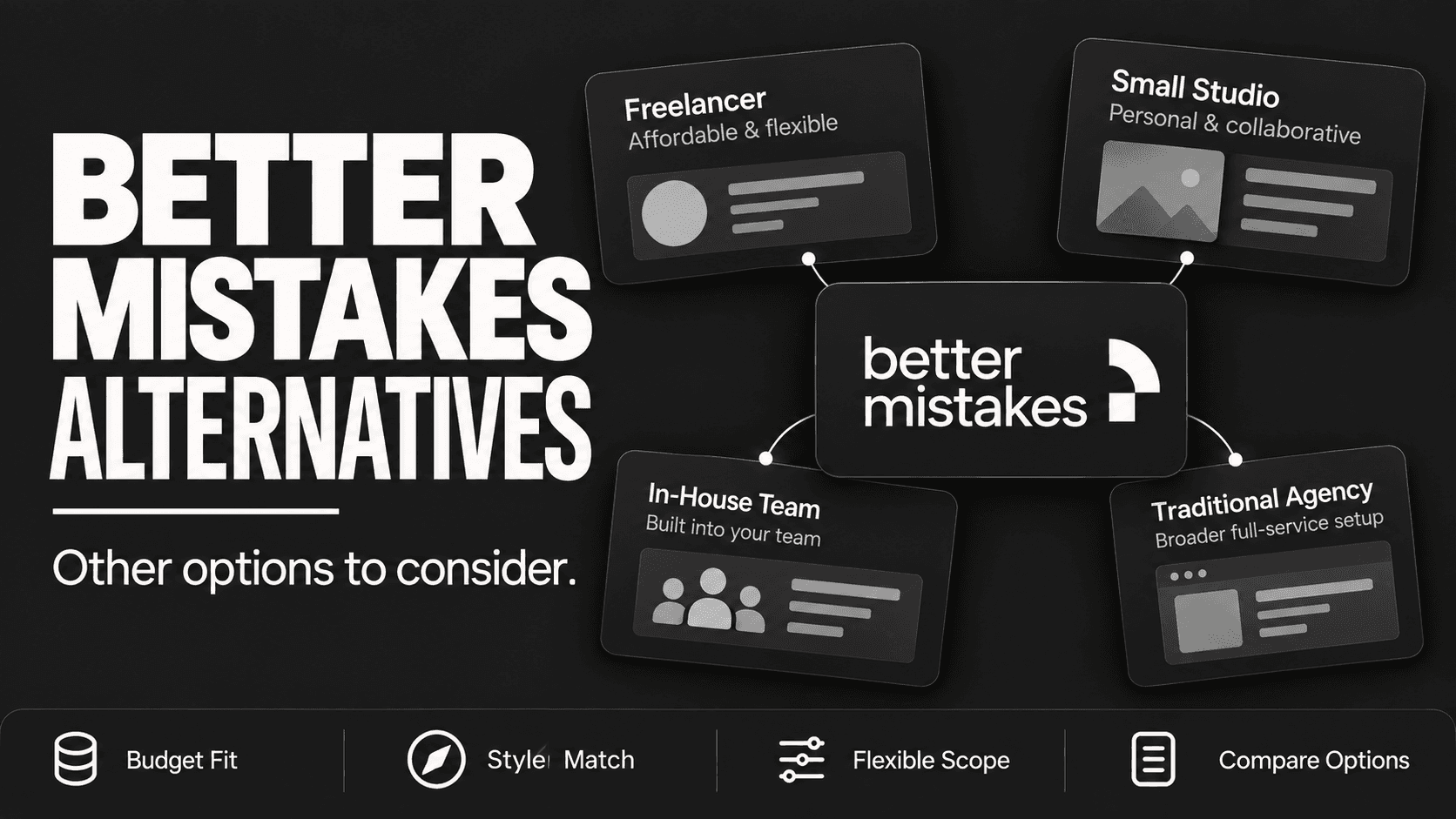
Best Better Mistakes Alternatives
Design studio | Specialty | Choose it instead when… |
|---|---|---|
Brand, copy, motion, UI/UX, and Webflow | Choose it when expressive creative direction and motion need to be integrated with the website. | |
Senior-led design, Webflow, CMS, training, and support | Choose it when direct senior access and a maintainable editor experience matter more than a large bench. | |
B2B SaaS, AI, Webflow, product, and growth design | Choose it when a tech company needs its website, landing pages, product visuals, and growth assets to feel consistent. | |
Webflow, custom development, SEO/AEO, CRO, and growth | Choose it when you want transparent project tiers plus search, conversion, and ongoing optimization. | |
Flexible Webflow design, development, and ongoing support | Choose it when transparent hourly pricing and flexible technical capacity matter. |
Disclosure: I run a smaller design and no-code studio, so I may include our services as a lower-budget or more flexible alternative where relevant. This does not mean Better Mistakes is bad. The goal is to help you compare options honestly.
Kedara can be worth comparing for landing pages, Figma UI, Webflow, Framer, and white-label agency support when you want a leaner scope and close collaboration. Compare the work and ask for a quick project-fit check; do not choose on price alone.
Final Verdict: Is Better Mistakes Worth It?
My honest view is that Better Mistakes is worth shortlisting when you are B2B technology companies that need brand and website work to feel like one system, plus agencies looking for a dependable development partner and can support a structured process. The public evidence makes the studio look legitimate, and its strongest value is the combination of design thinking, implementation, and a clearly defined operating model.
It is not the default choice for every budget. Public pricing is absent, and the broad offer can make scopes hard to compare. Buyers should separate must-have brand work from optional product, optimization, and maintenance items so the proposal stays readable. Get a detailed proposal, compare it with two relevant alternatives, verify the exact team, and judge the work against your own sales process, content operations, and technical constraints—not against awards or visual polish alone.
FAQ
Is Better Mistakes legit?
Yes. It has an active official presence and supporting work, platform, or client evidence. Still complete normal reference, security, and contract checks.
How much does Better Mistakes cost?
I could not find a public project price list on the pages reviewed. The studio positions around custom brand, website, development, migration, and optimization work, so buyers should request a detailed scope and compare what is included in strategy, design, build, and support.
What services does Better Mistakes offer?
Its verified public offer includes brand strategy and identity, web and product design, webflow and framer development, custom and shopify development, optimization.
Does Better Mistakes provide development?
Yes. Its public offer includes implementation within Webflow, Framer, Shopify, and custom web development, though custom engineering, integrations, and support should be confirmed in the written scope.
Who is Better Mistakes best for?
It is best for B2B technology companies that need brand and website work to feel like one system, plus agencies looking for a dependable development partner.
Who should avoid Better Mistakes?
It is less suitable for buyers who only want the cheapest template installation or who need a narrow commodity build with no strategy, brand, or technical depth.
What are the best Better Mistakes alternatives?
Useful alternatives include One Branding, Ficturo, Grafit Agency, Code & Wander, Povio, depending on budget, platform, migration complexity, creative scope, and ongoing support needs.
Sources / References
Pricing, ratings, package details, awards, partnerships, team details, and public claims can change. Verify them directly before hiring.

